Described by contemporaries as coming from an obscure and humble family background, he may have trained as an apprentice to William Cooke in the Worshipful Company of Stationers starting in 1557. Fun fact – Peter Bellerby is a member of the Worshipful Company of Stationers today.
Side note for those who may not be familiar – what is The Worshipful Company of Stationers? It is a historic London trade guild—similar to an old-school combination of a medieval craft union, a trade association, and a professional society.
The American equivalent: Imagine a local craft guild or union from the colonial era, combined with a modern industry association like the American Booksellers Association or the National Newspaper Association, but running continuously for over 600 years.
In medieval London, most traveling craftsmen moved around. However, writers, illuminators (artists who decorated manuscripts), bookbinders, and booksellers set up fixed-position stalls or “stations” right outside the walls of St. Paul’s Cathedral. Because they stayed put at a “station,” they became known as stationers (which is also where we get the word stationery).
.
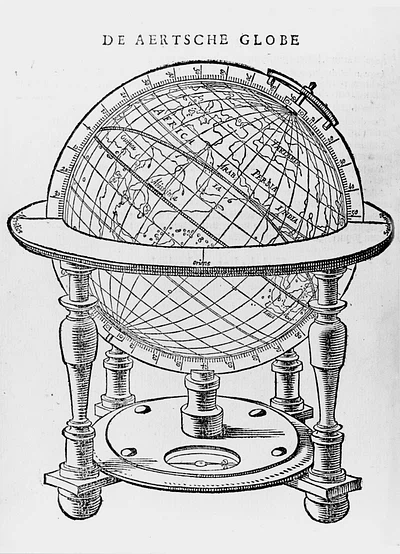 By the 1580s, Molyneux operated a workshop in Lambeth on the south bank of the River Thames, building a reputation for crafting precision scientific instruments such as compasses and hourglasses.
.
Manufacturing early printed globes required substantial backing.
.
The largest and most prestigious globes of the Elizabethan era—such as those produced by Emery Molyneux in the late 1500s—cost up to £20 each (roughly equivalent to thousands of pounds or around £160,000+ in modern relative value when factoring early capital investments). These were high-status luxury items purchased by royalty, noblemen, and academic institutions.
.
Molyneux was introduced to London merchant William Sanderson, who heavily financed the costly production of the globes (contributing over £1,000).
.
.
In the Elizabethan era (1558–1603), £1,000 was an immense fortune, equivalent to roughly £200,000 to £350,000 in basic retail purchasing power today, or £3 million to £6 million when compared to average annual wages.
Molyneux gathered geographical and astronomical data from a prominent Elizabethan circle, including the writer Richard Hakluyt, mathematicians Robert Hues and Edward Wright, and explorers such as Sir Francis Drake, Sir Walter Raleigh, and John Davis.
.
The globe gores were engraved by the famous Dutch cartographer Jodocus Hondius, who was then working in London.
.
Early 16th-century gores were often made using woodcuts, but by the mid-1500s, cartographers shifted to copperplate engraving (pioneered and refined by figures like Gerardus Mercator). Copper plates allowed for much finer, more intricate detail than wood.
.
.
If a woodcut globe needed corrections, the entire block had to be re-sculpted from scratch. Copper plates could be modified or re-engraved as new explorations, continents, and trade routes were discovered during the Age of Discovery.
.
Engraving plates allowed printers to ink and pull multiple copies of the same gore set. These printed paper segments were then wet and stretched across handcrafted spheres the same as we do today. Spheres of the time were hollow and made from papier-mâché or plaster-coated balls and it was customary to have a pair of terrestrial and celestial globes.
.
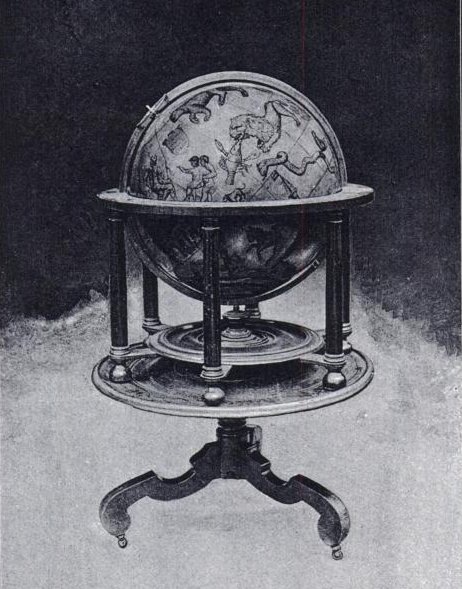
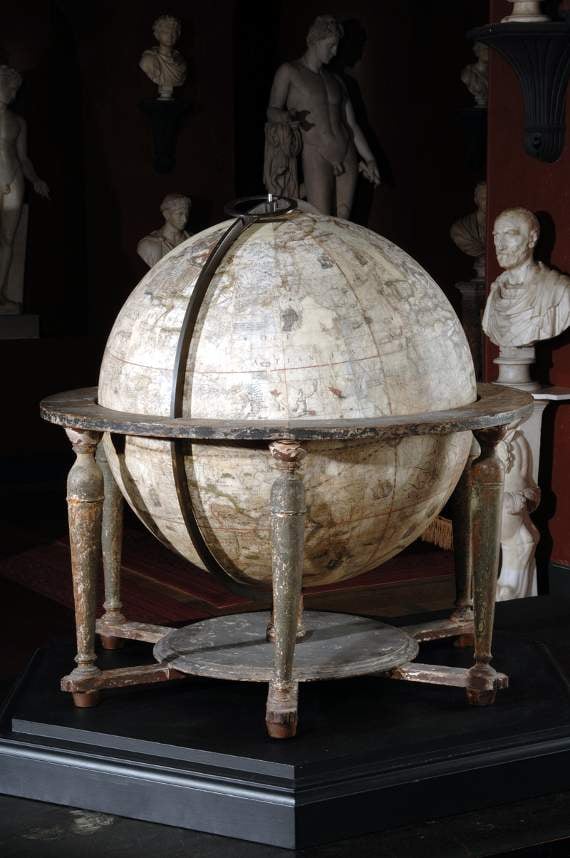
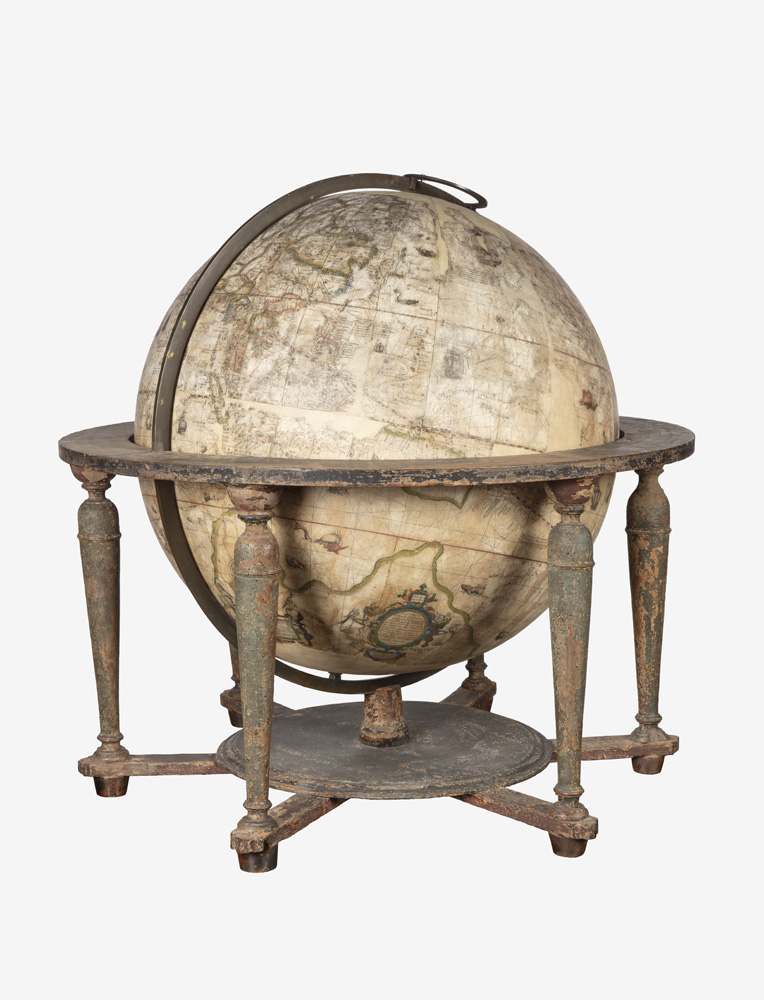
Completed around 1592, the terrestrial and celestial globes were presented to Queen Elizabeth I, with larger versions distributed to nobility and academic institutions, and smaller ones used as navigation aids at sea. They were notably engineered to resist humidity at sea.
.
In the mid-1590s, Molyneux shifted focus to a new invention—a design for a cannon. He received a royal grant and annuity from Queen Elizabeth I, which he later surrendered.
.
.
Around 1596–1597, Molyneux and his wife Anne emigrated to Amsterdam to better market his work to European powers.
.
He died in Amsterdam in June 1598, apparently in poverty. With his death, the early English printed-globe industry effectively halted.
.
Only a small handful of Molyneux globes survive today:
.
• Petworth House (West Sussex): Holds the sole surviving first-edition terrestrial globe from 1592.
.
• Middle Temple (London): Displays a rare surviving pair (terrestrial and celestial globes from 1603) in its library.
.
.
Commission a bespoke globe in modern times –
www.bellerbyandco.com
info@bellerbyglobemakers.com
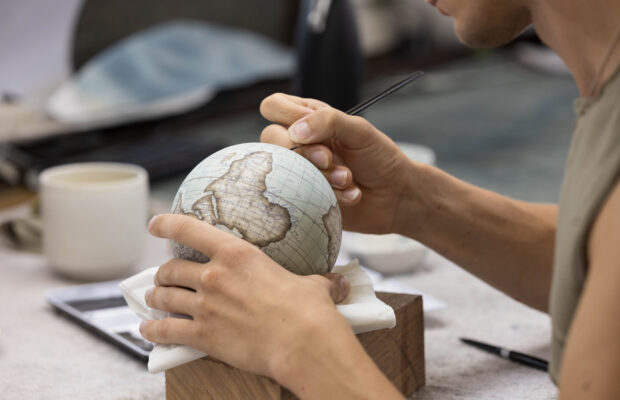
Bellerby & Co Globemakers. We also create custom maps of regions, countries, cities, the world – and everything in-between including imaginary worlds. Our team of cartographers, designers and illustrators work together to create accurate mapping that is also a one-of-a-kind work of art.


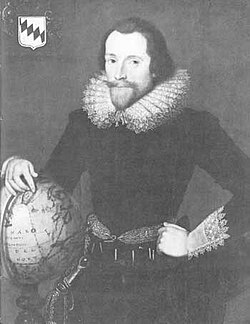 Emery Molyneux was an Elizabethan mathematician and instrument maker who created the first terrestrial and celestial globes ever made in England.