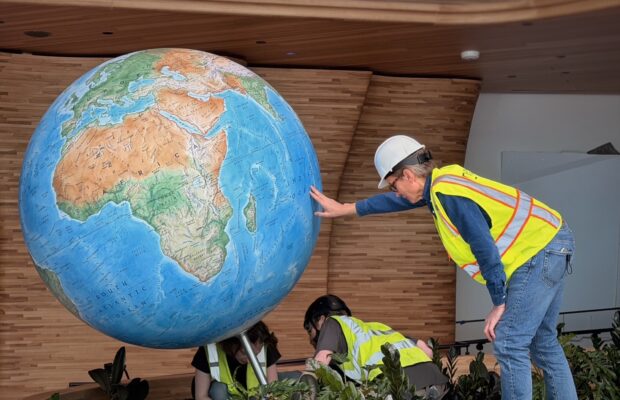
The first recorded world globe was likely a large, non-surviving terrestrial sphere built around 150 BC by the Greek philosopher Crates of Mallus.
This globe was written about by the geographer Strabo (63/64BCE-24CE), this confirmed that people have used globes to model the world around them since antiquity. This early model represented the Hellenistic known world divided into four landmasses separated by oceans and it is said that the globe was 10 feet in diameter.
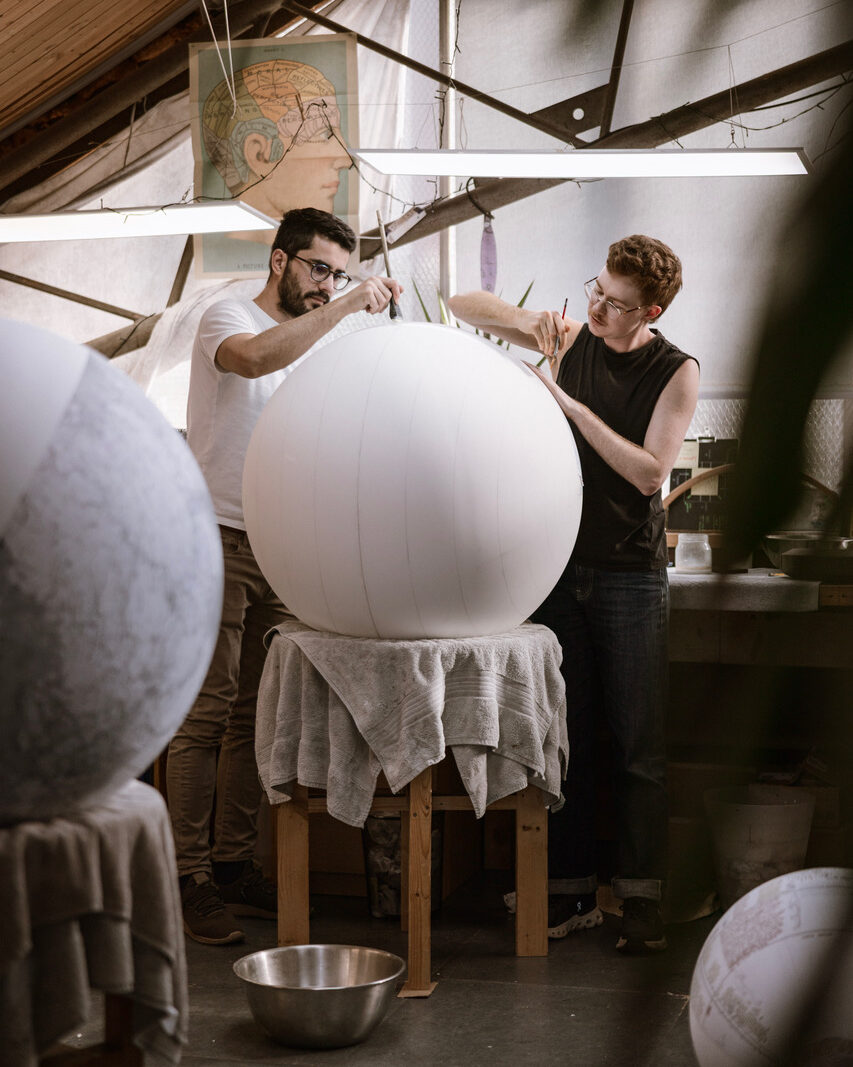
Traditionally handcrafted globes are of course extremely delicate and the surviving evidence for early globe use is sparse.
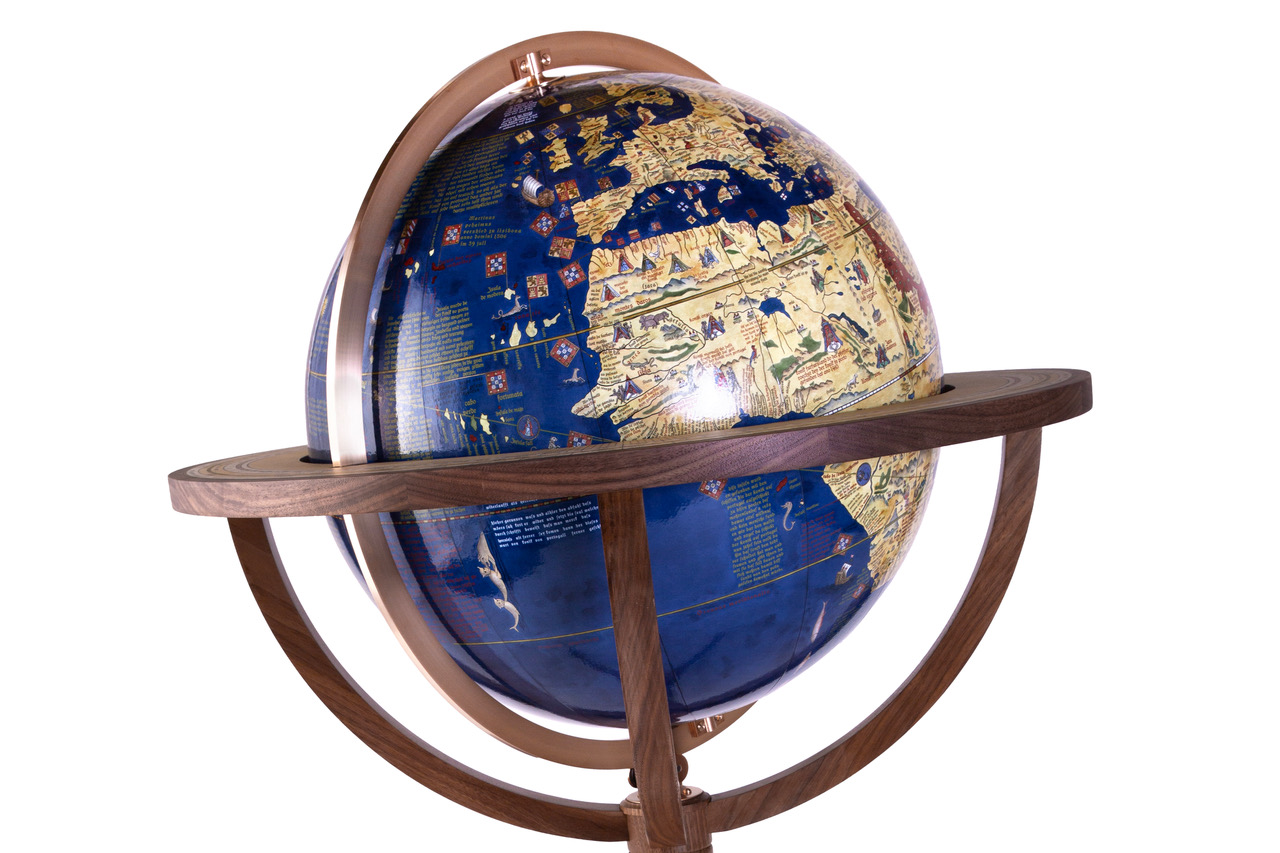
The Oldest Surviving Globe was created by German navigator Martin Behaim between 1490 and 1492, the Erdapfel (Earth Apple) is the oldest extant terrestrial globe in the world. It was made just before Christopher Columbus returned from the Americas, meaning it completely omits the New World and depicts an oversized Eurasian landmass. Behaim’s globe showed seaborne explorers, details of overseas commodities, market places and local trading history.
The 16th century
Gemma Frisius, a Dutch cartographer, mathematician and instrument maker who worked at Louvain, wrote (1530) :
“[T]he mounted globe … is the only one of all instruments whose frequent usage delights astronomers, leads geographers, confirms historians, enriches and improves legists [les legists], is admired by grammarians, guides pilots, in short, aside from its beauty, its form is indescribably useful and necessary for everyone.”
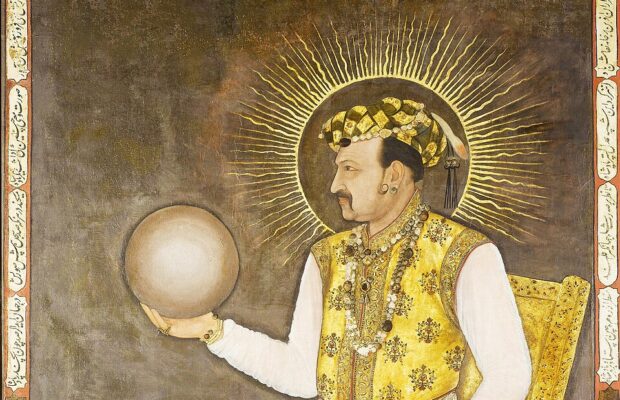
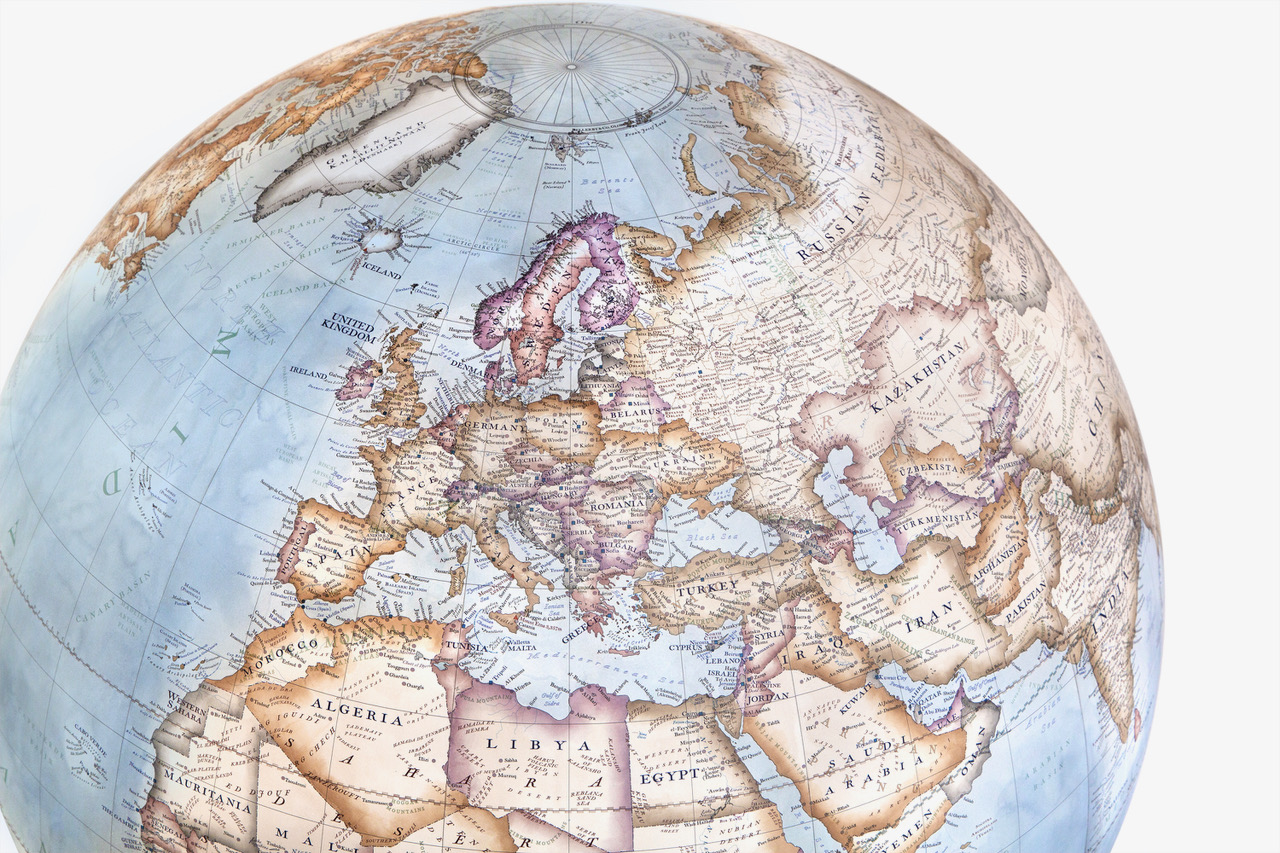
Frisius’ account of globes as beautiful as well as useful is significant – globes have tended to attract attention as art objects, as well as for their depiction of geographically, politically and economically important lands. Globes were often exchanged as gifts among important rulers, since they signified command of the world, but were also suitably stately for presentation to powerful figures.
 The 17th century
Globes retained their decorative function in the 17th century, and some innovative designs were produced that promoted the gentlemanly use of globes as accessories or furniture items. Pocket globes were first produced in England by Joseph Moxon (1627-1691) in 1673, and gentlemen might well have used these miniature instruments as status symbols. Moxon also collaborated with Roger Palmer to make the ‘English Globe’ in 1679 (Image 1), which was best used in the garden. Indeed, the fact that the ‘English Globe’ could not be rotated on its stand meant that it could only be used for latitudes matching that of the south of England and would have been useless on sea voyages. Pocket globes and instruments such as the ‘English Globe’ meant that makers could promote globes among new audiences.
The 18th century
sometimes seen as a second ‘age of exploration’, following the initial voyages of discovery in the late 15th and 16th centuries. When four Royal Navy ships were wrecked off the Scilly Isles in 1707 on account of navigational errors, the British Government established the Commissioners for the Discovery of the Longitude at Sea (also known as the Board of Longitude), which offered large monetary prizes to anyone who could devise a method for accurately finding longitude. This motivated a more practical approach to sailing in the 18th century.
Globes sat awkwardly among air pumps and microscopes, the established apparatus of the rationalists. Many judged that globes could only be used to record, but not to make, discoveries. For example, Joseph Priestley (1733-1804), a Fellow of the Royal Society, felt that globes were only explanatory devices, which “like books, have no uses more extensive than the view of human ingenuity”.
In spite of the cynicism that some felt towards globes, they proved useful for recording the new discoveries made in the 18th century, including many of the Pacific islands and New Caledonia. Existing territories were also updated in line with continuing exploratory ventures. For instance, California, which had been depicted as an island since the early 17th century, was mapped as a peninsula with increasing frequency throughout the 18th century.

The 19th century
Globes had traditionally had some role in the training of navigators and astronomers and the use of the instruments in education underwent a major expansion in the 19th century. Strategies to bring the globe into the world of the child included making smaller versions and using the objects as part of a game.
Pocket globes could have provided small, if not accurate, representations of larger globes at relatively low cost, so that children could learn about the various rings on globes, or about the approximate arrangement of the continents. Other globe makers concentrated on trying to make their globes as portable as possible, so that the objects could be carried from classroom to classroom or between the homes of different pupils in the case of travelling tutors.
The ‘English Globe’ is a rare example of an immobile globe, whose sphere does not rotate but is fixed in place over a planisphere. Its fixed position allows complex calculations to be performed more easily than with a turning sphere.
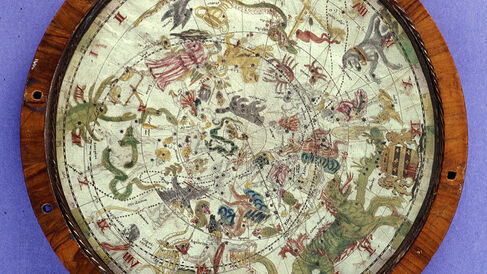
Roger Palmer (1634-1705), Earl of Castlemaine and Cambridge-educated son of Sir James Palmer, collaborated with Joseph Moxon (1627-1691), son and apprentice of printer James Moxon, in 1679 to produce an instrument that they named the ‘English Globe’. Three examples of English Globes are preserved at the University of Cambridge in the University Library, Pembroke College, and the Whipple Museum.
The English Globe has a sphere fixed in position on a pedestal rather than being held in a meridian ring that could be rotated in a horizon band. It represents the Earth as stationary rather than moving, as it is in the Copernican system. The Earl of Castlemaine did not believe in a geocentric universe but constructed the globe in this way to make it more practically useful: the presence of lead shot.
Castlemaine said in The English Globe, published in 1679, that the globe’s novel construction meant that it could be used to solve many conventional practical globe problems.
The sphere of the English Globe was set above a planisphere appropriate for the latitude of London and was fixed with the south of England uppermost, parallel with the horizon. This meant that when composed (that is, levelled and orientated north-south in the Sun’s rays) the English Globe was an exact replica of the Earth itself. Most of the English Globe’s many functions, as described in Castlemaine’s publication, required the globe to be used outside on a fine day so that the rays of the Sun fell on the sphere as they did on the Earth itself. Many of the English Globe’s functions pertained to dialling, the art of constructing and using sundials, which became increasingly popular in the course of the 17th century.
Castlemaine designed the English Globe after seeing one of Moxon’s pocket globes and Moxon executed Castlemaine’s design, from cartography to instrument construction. Moxon used existing materials to craft the unique instrument, updating existing plates for the cartography and then applying the printed gores to a blank sphere originally intended for a turning globe.
Moxon also brought his own interests as a printer to bear on the English Globe, using different typescripts to distinguish old and new names for the same localities. For instance, archaic names for localities were inscribed in Gothic type. Thus, Sumatra and Zeilan (Sri Lanka) were also labelled ‘Taprobane’ as they had both previously been known.
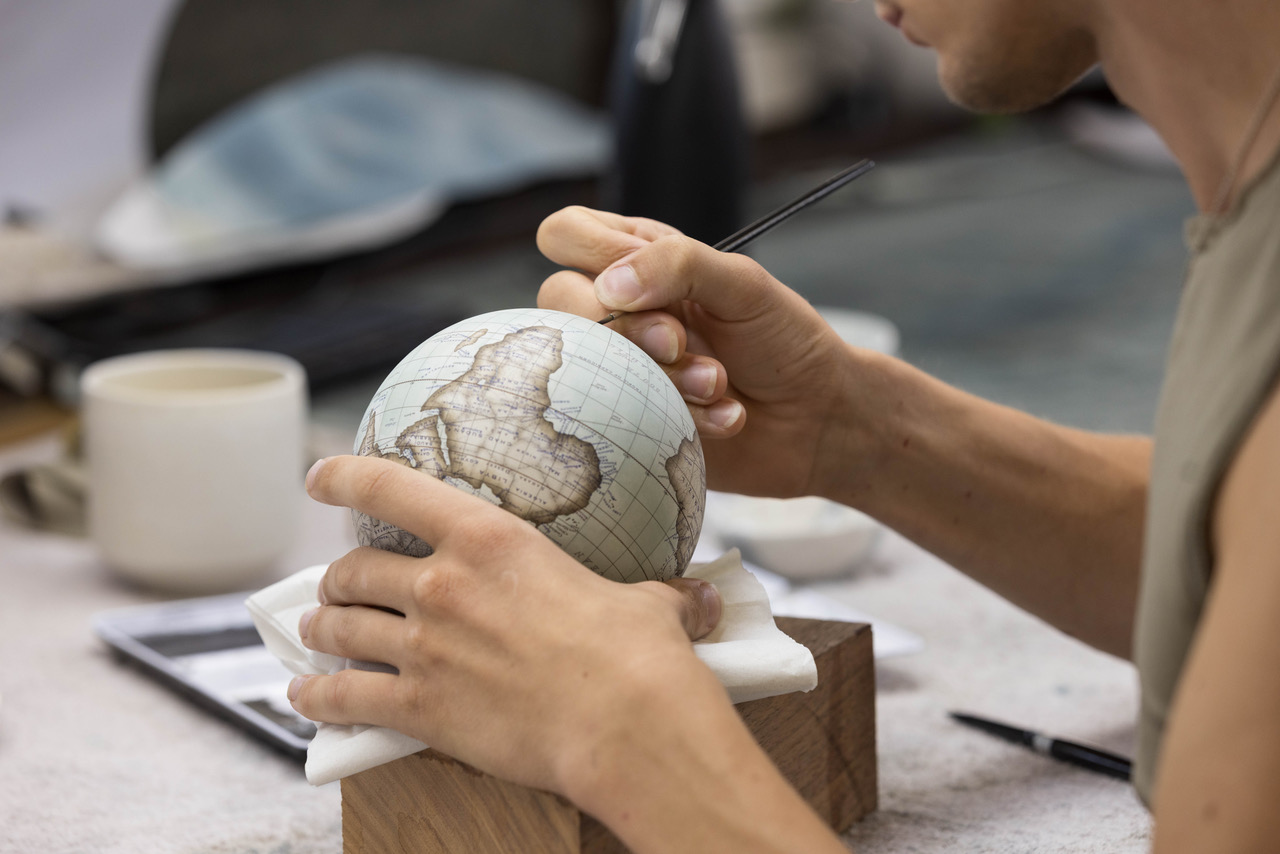
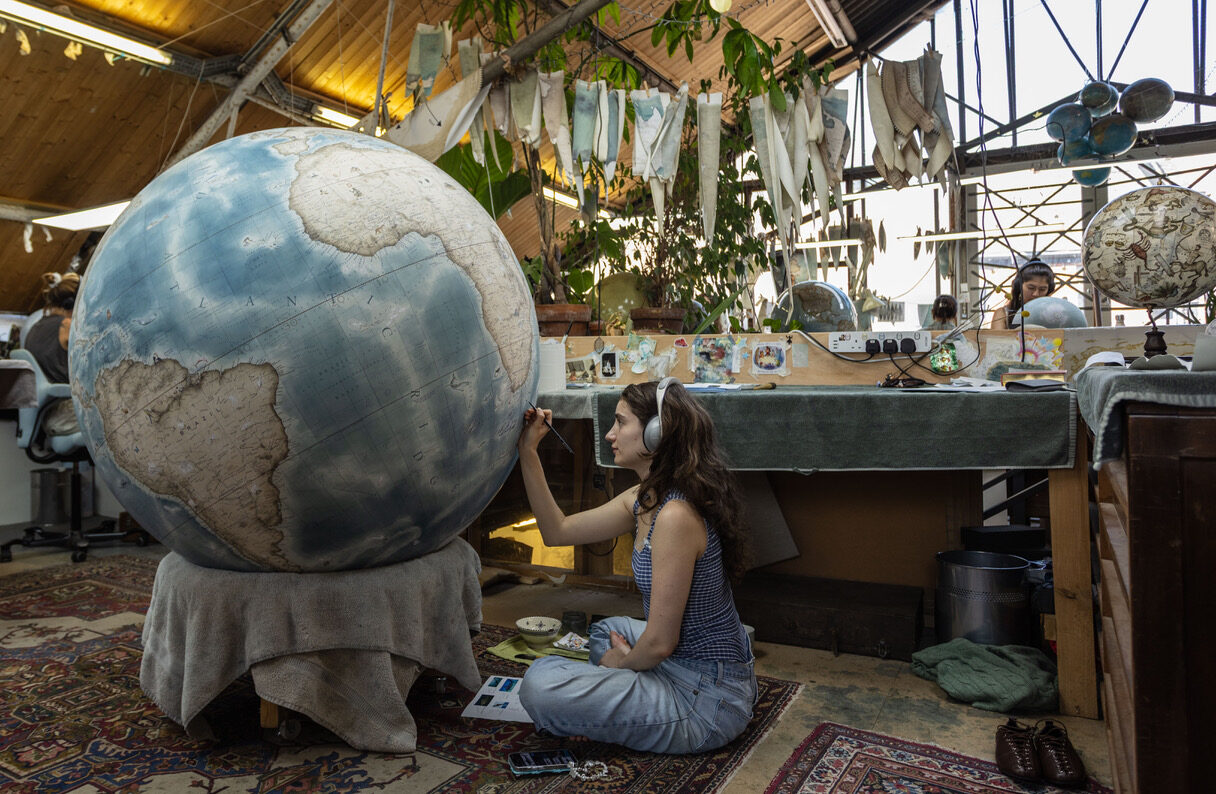
Main photo by Euan Myles. Making photo by Bea Lubas. Pocket Globe and 127cm Churchill Gloe being painted are photos by Roff Smith