When Peter Bellerby was a boy he wanted a globe. Specifically he wanted, in his words, ‘one of those gaudy bar globes you‘d see in the Sunday supplements.’ The kind that you could open up at the equator and bottles of spirits would sit happily inside. He begged his father to buy one. The request was refused.
Maybe that was why, in 2008, he decided to build his dad a globe. It would be an 80th birthday present – and also a sort of retribution. Bellerby, who’s from Suffolk, was in his 30s at the time and had just stopped working in property development. If he could help build a house, fix a burst pipe, mend a leaking bathroom, he reckoned he could also make a globe.
The earliest surviving terrestrial globe was built in Germany in 1492 by the textile merchant and cartographer Martin Behaim. The Erdapfel – German for ‘earth apple’ – is a linen ball and after it was created, the globe business spun along smoothly for several centuries. But in the 1900s, globe-making – the traditional, handmade variety, not the kind you get in a factory – stopped. It meant that Bellerby couldn’t find any instructions about how to make one. There were no books, no videos, no diagrams. His method was ‘literally just trial and error’. Now, budding globe builders won’t be so clueless because The Globemakers, Bellerby’s first book, will be published this month.
‘I had no idea about anything,’ he says. ‘I didn’t know whether to construct a sphere out of two halves or whether to form one whole.’ He couldn’t work out how to get flat paper to stretch over a round surface. He couldn’t find the right glue, as anything too strong would tear holes through the paper.
He threw away six, seven, sometimes eight globes a week. The materials were expensive and within around three months Bellerby had spent ‘tens of thousands of pounds’. It was at this point that he realised the project had to be more than a birthday present. So he sold his car, used the money from a previous house sale, maxed out nine credit cards, rented a studio in Northeast London and became a full-time globe-maker. You might think this was punchy behaviour from someone yet to actually make a globe, but Bellerby was adamant. ‘I was so deep down this rabbit hole that coming out, poking my head over the top and saying “I failed” was not an option.’
It took him two years to finish the perfect globe, after which he began hiring and training people to build them alongside him. Today, Bellerby, 58, and his company produce what they call the only ‘truly bespoke’ handmade globes in the UK. Bellerby & Co ships about 500 a year, has a four-month to one-year waiting list and employs 28 people in the most beautiful office I have ever seen: a wood-panelled studio in London’s Stoke Newington.
I visit on a warm day in August. There are painters quietly shading in globes, dabbing their brushes on watercolour stained towels. Cut-out sections of maps hang to dry on washing lines dangling from the ceiling. At the back of one room is an enormous triangular window; the studio is so bright it looks almost yellow.

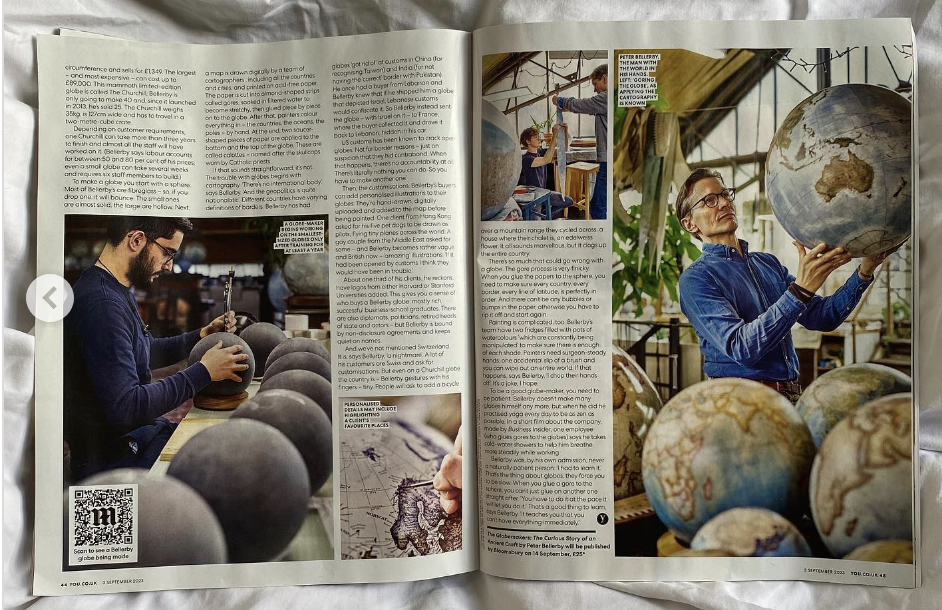
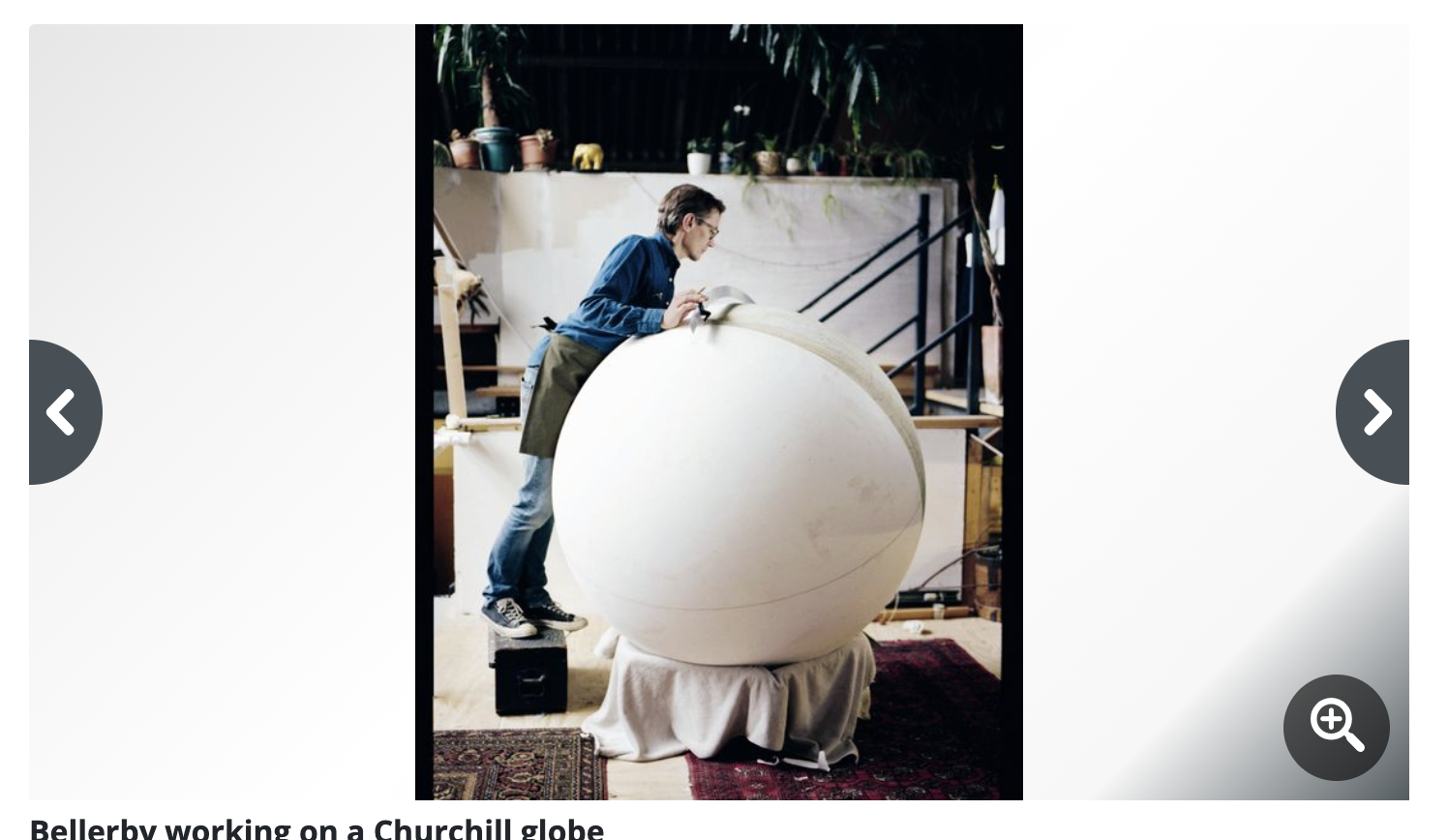
These really aren’t the gaudy drinks-cabinet globes of Bellerby’s memory. His most popular product is 22cm in circumference and sells for £1,349. The largest – and most expensive – can cost up to £89,000. This mammoth limited-edition globe is called The Churchill; Bellerby is only going to make 40 and, since it launched in 2013, he’s sold 25. The Churchill weighs 35kg, is 127cm wide and has to travel in a two-metre-cube crate.
Depending on customer requirements, one Churchill can take more than three years to finish and almost all the staff will have worked on it. (Bellerby says labour accounts for between 50 and 80 per cent of his prices; even a small globe can take several weeks and requires six staff members to build.)
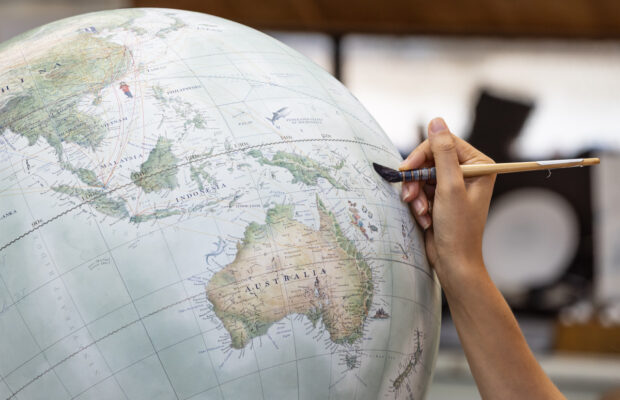
To make a globe you start with a sphere. Most of Bellerby’s are fibreglass – so, if you drop one, it will bounce. The small ones are almost solid, the large are hollow. Next, a map is drawn digitally by a team of cartographers , including all the countries and cities, and printed on acid-free paper. The paper is cut into almond-shaped strips called gores, soaked in filtered water to become stretchy, then glued piece by piece on to the globe. After that, painters colour everything in – the countries, the oceans, the poles – by hand. At the end, two saucer-shaped pieces of paper are applied to the bottom and the top of the globe. These are called calottes – named after the skullcaps worn by Catholic priests.
If that sounds straightforward, it’s not. The trouble with globes begins with cartography. ‘There’s no international body,’ says Bellerby. ‘And the geopolitics is quite nationalistic.’ Different countries have varying definitions of borders. Bellerby has had globes ‘got rid of’ at customs in China (for recognising Taiwan) and India (for not having the ‘correct’ border with Pakistan). He once had a buyer from Lebanon and Bellerby knew that if he shipped him a globe that depicted Israel, Lebanese customs would confiscate it. So Bellerby instead sent the globe – with Israel on it – to France, where the buyer collected it and drove it back to Lebanon, hidden in his car.
US customs has been known to crack open globes. Not for border reasons – just on suspicion that they hid contraband. When that happens, ‘there’s no accountability at all. There’s literally nothing you can do. So you have to make another one.’
Then, the customisations. Bellerby’s buyers can add personalised illustrations to their globes. They’re hand-drawn, digitally uploaded and added to the map before being painted. One client from Hong Kong asked for his five pet dogs to be drawn as pilots, flying tiny planes across the world. A gay couple from the Middle East asked for some – and Bellerby becomes rather vague and British now – ‘amazing’ illustrations. ‘If it had been opened by customs I think they would have been in trouble.’
About one third of his clients, he reckons, have logos from either Harvard or Stanford Universities added. This gives you a sense of who buys a Bellerby globe: mostly rich, successful business-school graduates. There are also diplomats, politicians, retired heads of state and actors – but Bellerby is bound by non-disclosure agreements and keeps quiet on names.
And we’ve not mentioned Switzerland. It is, says Bellerby, ‘a nightmare’. A lot of his customers are Swiss and ask for customisations. But even on a Churchill globe the country is – Bellerby gestures with his fingers – tiny. People will ask to add a bicycle over a mountain range they cycled across, a house where their chalet is, an edelweiss flower. It all sounds marvellous, but it clogs up the entire country.
There’s so much that could go wrong with a globe. The gore process is very finicky. When you glue the papers to the sphere, you need to make sure every country, every border, every line of latitude, is perfectly in order. And there can’t be any bubbles or bumps in the paper, otherwise you have to rip it off and start again.
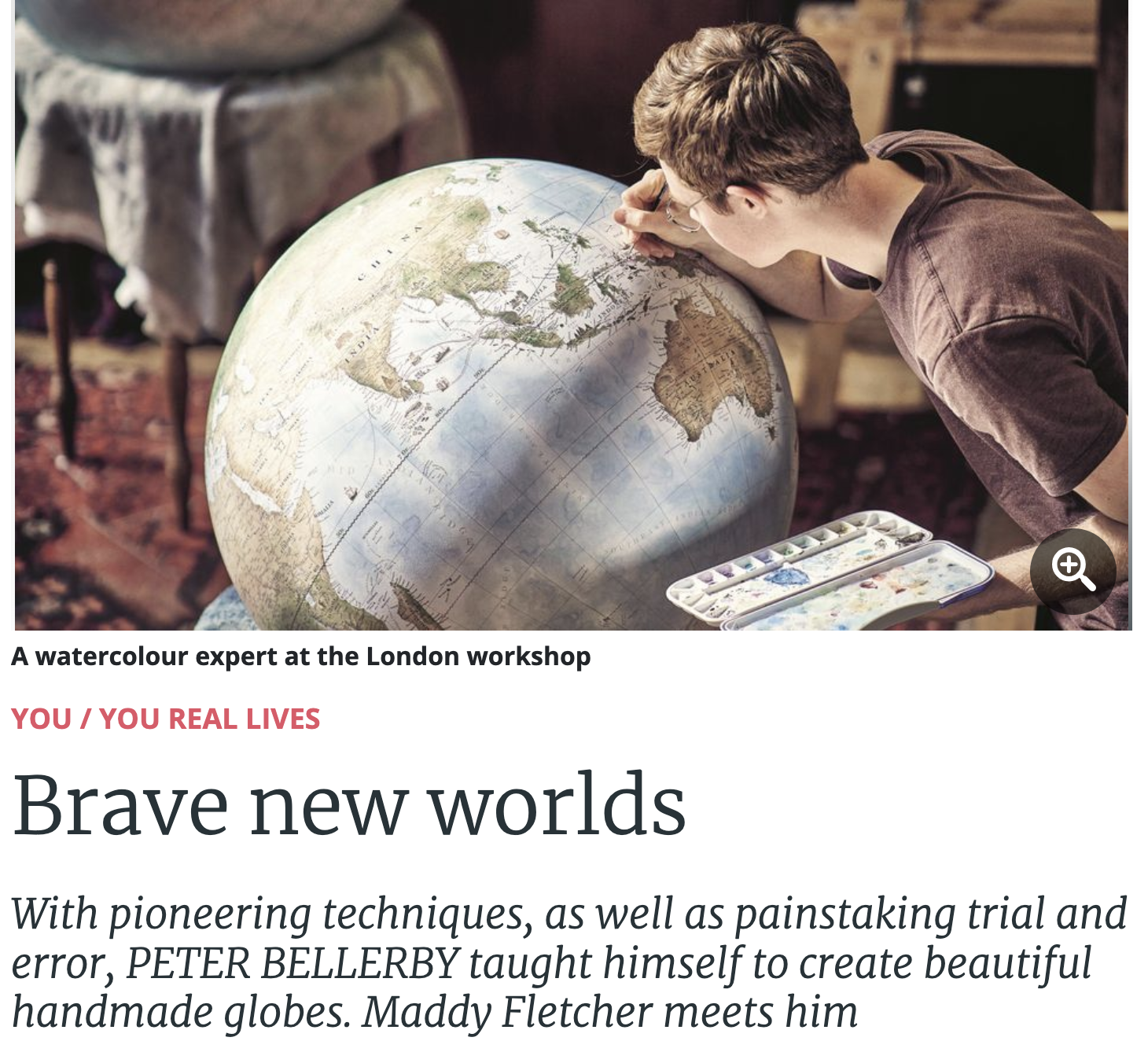
Painting is complicated, too. Bellerby’s team have two fridges filled with pots of watercolours ‘which are constantly being manipulated’ to make sure there is enough of each shade. Painters need surgeon-steady hands; one accidental slip of a brush and you can wipe out an entire world. If that happens, says Bellerby, ‘I chop their hands off’. It’s a joke, I hope.
To be a good globe-maker, you need to be patient. Bellerby doesn’t make many globes himself any more, but when he did he practised yoga every day to be as zen as possible. In a short film about the company, made by Business Insider, one employee (who glues gores to the globes) says he takes cold-water showers to help him breathe more steadily while working.
Bellerby was, by his own admission, never a naturally patient person: ‘I had to learn it.’ That’s the thing about globes, they force you to be slow. When you glue a gore to the sphere, you can’t just glue on another one straight after. ‘You have to do it at the pace it will let you do it.’ That’s a good thing to learn, says Bellerby. ‘It teaches you that you can’t have everything immediately.’
The Globemakers: The Curious Story of an Ancient Craft by Peter Bellerby will be published by Bloomsbury on 14 September, £25. TO ORDER A COPY FOR £21.25 UNTIL 17 SEPTEMBER GO TO MAILSHOP.CO.UK/BOOKS OR CALL 020 3176 2937. FREE UK DELIVERY ON ORDERS OVER £25
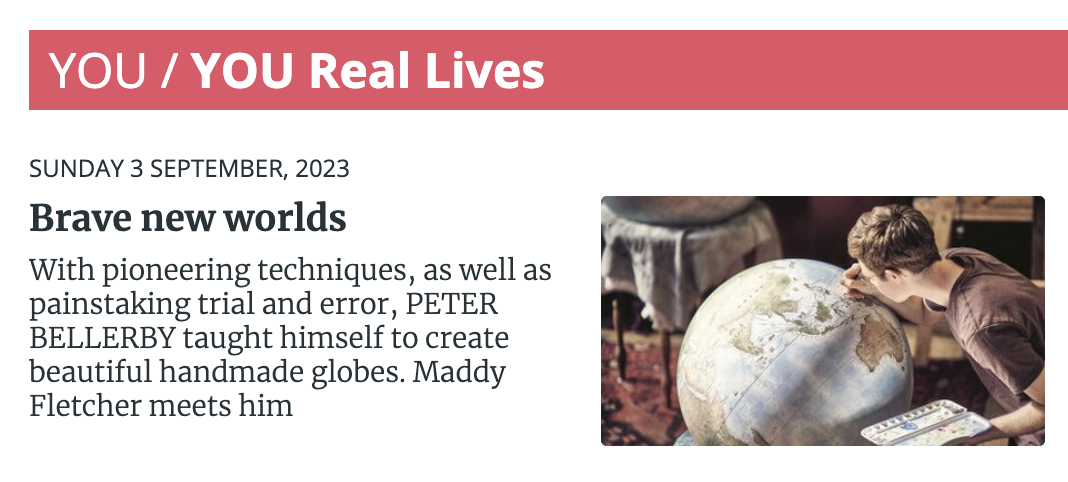
Photos featured are by Euan Myles.