Parchment Cassini | Historic 1942 Map | 36cm Globe
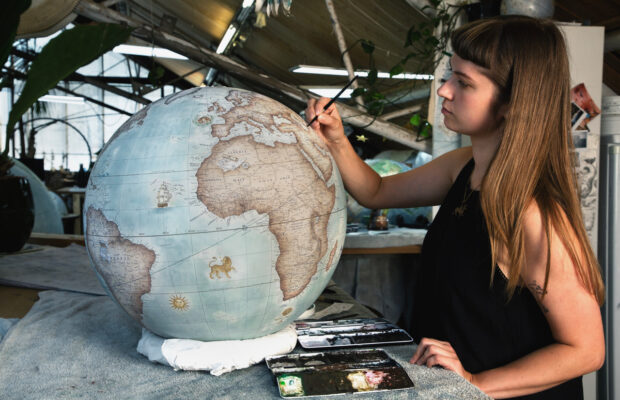
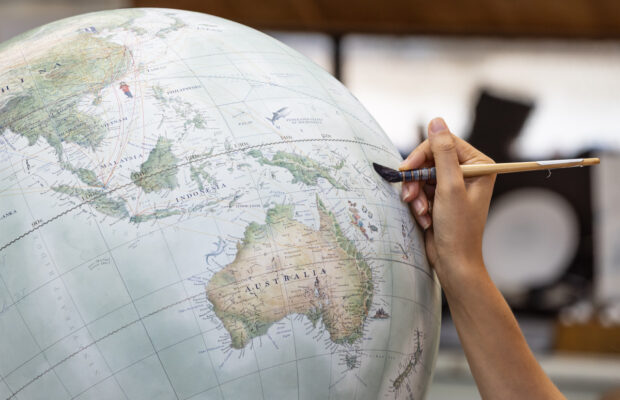
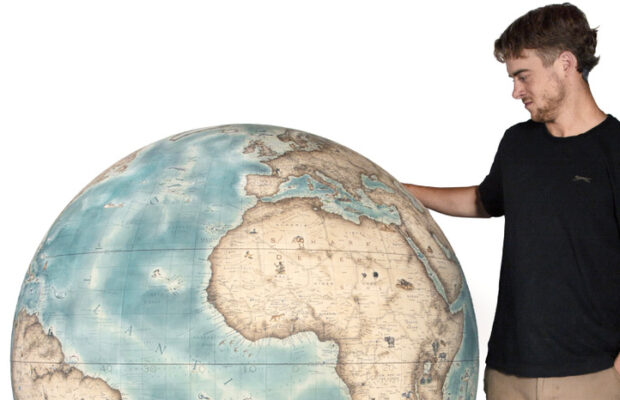
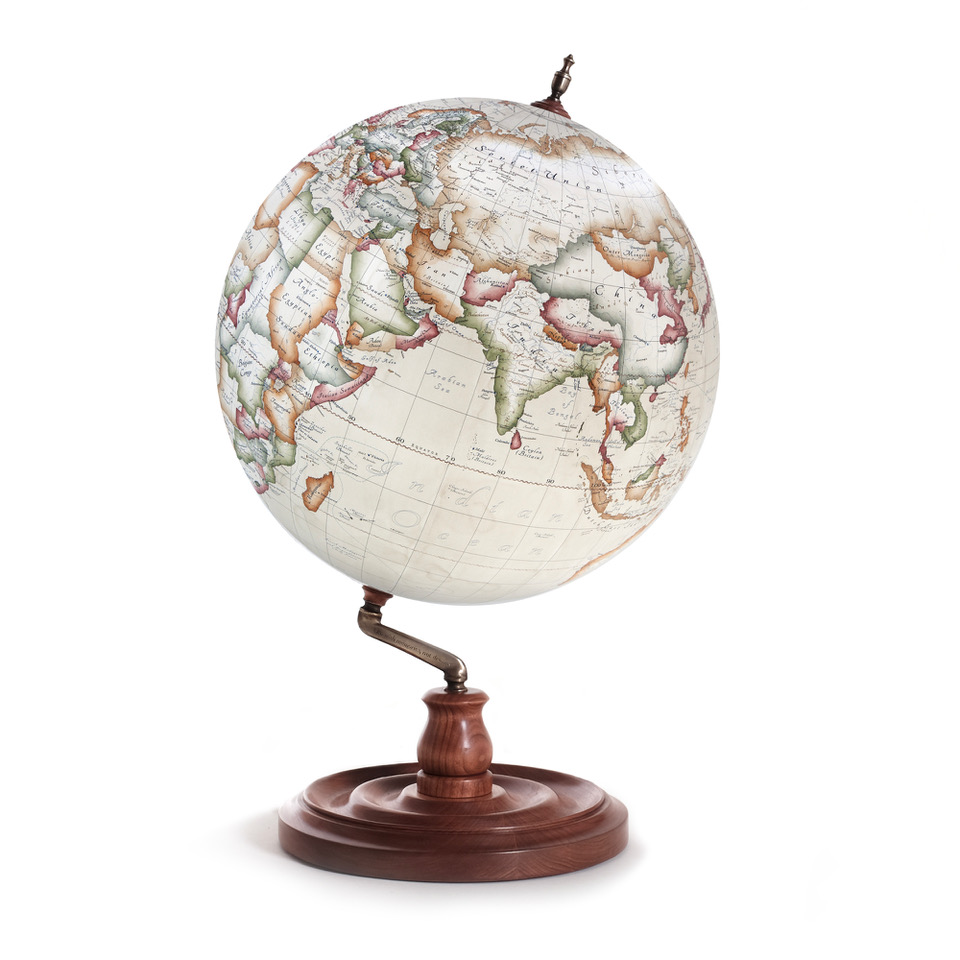
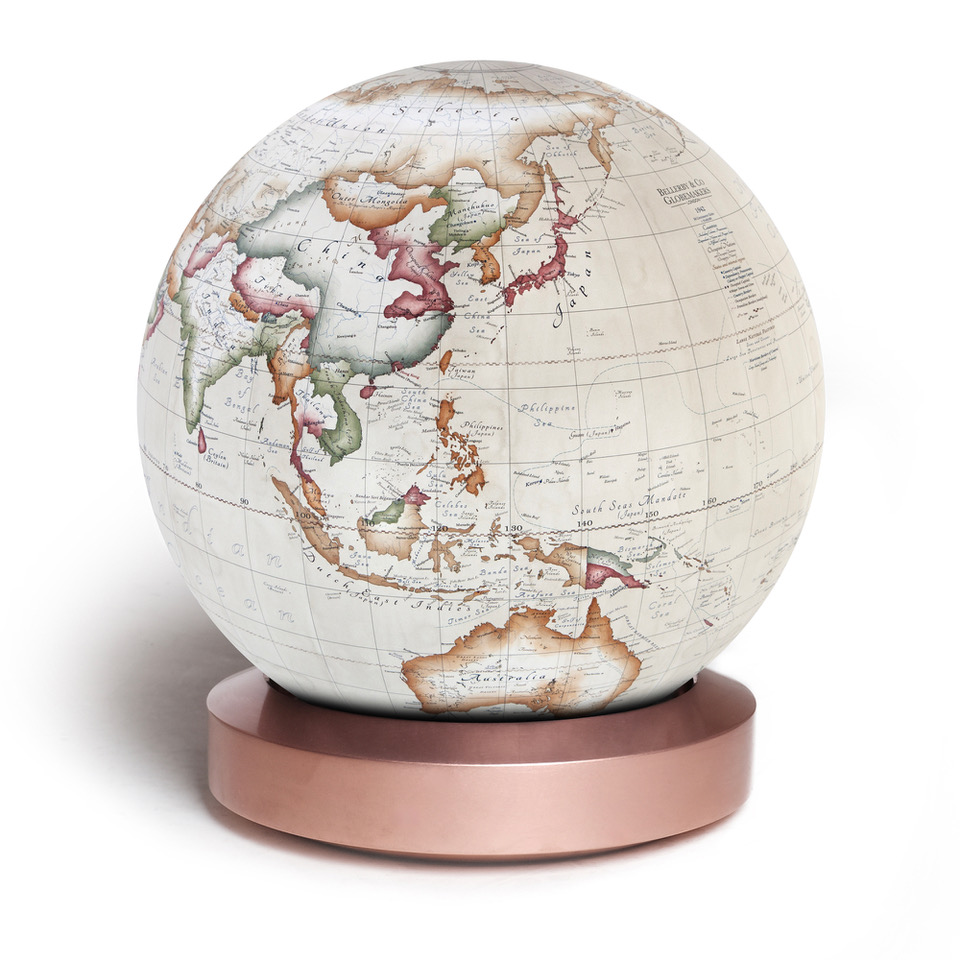
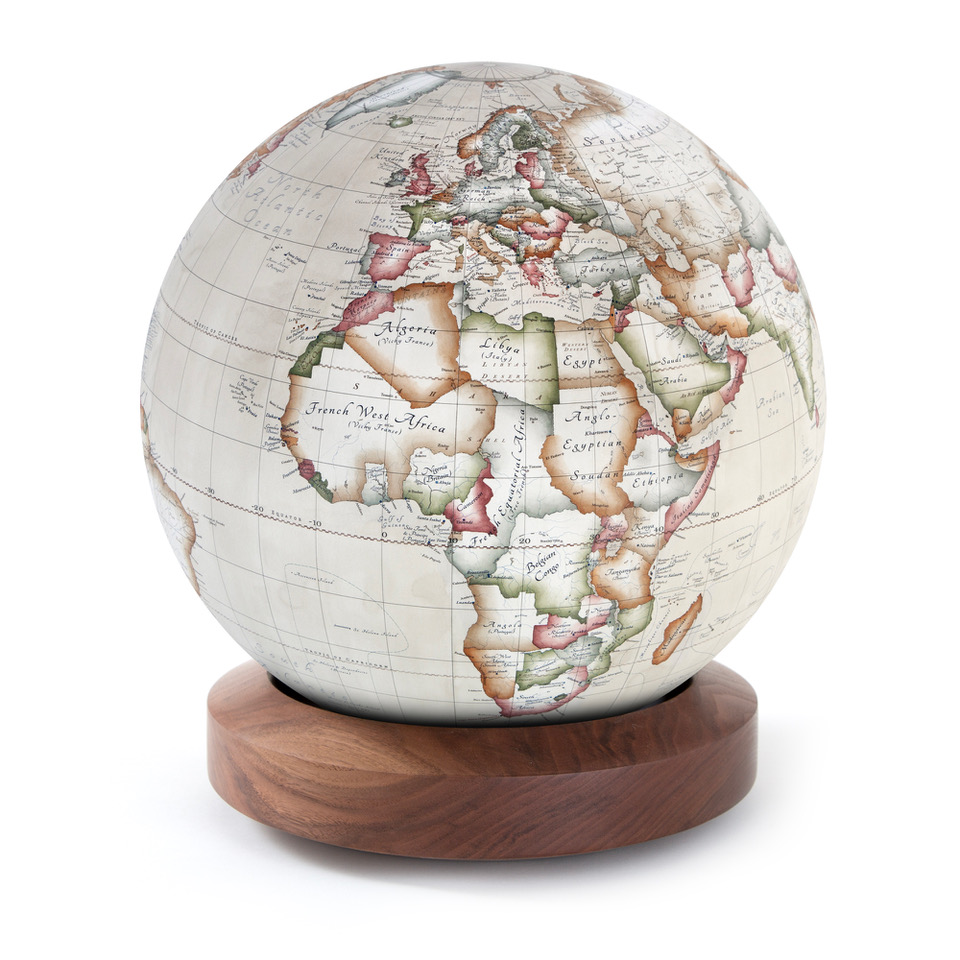
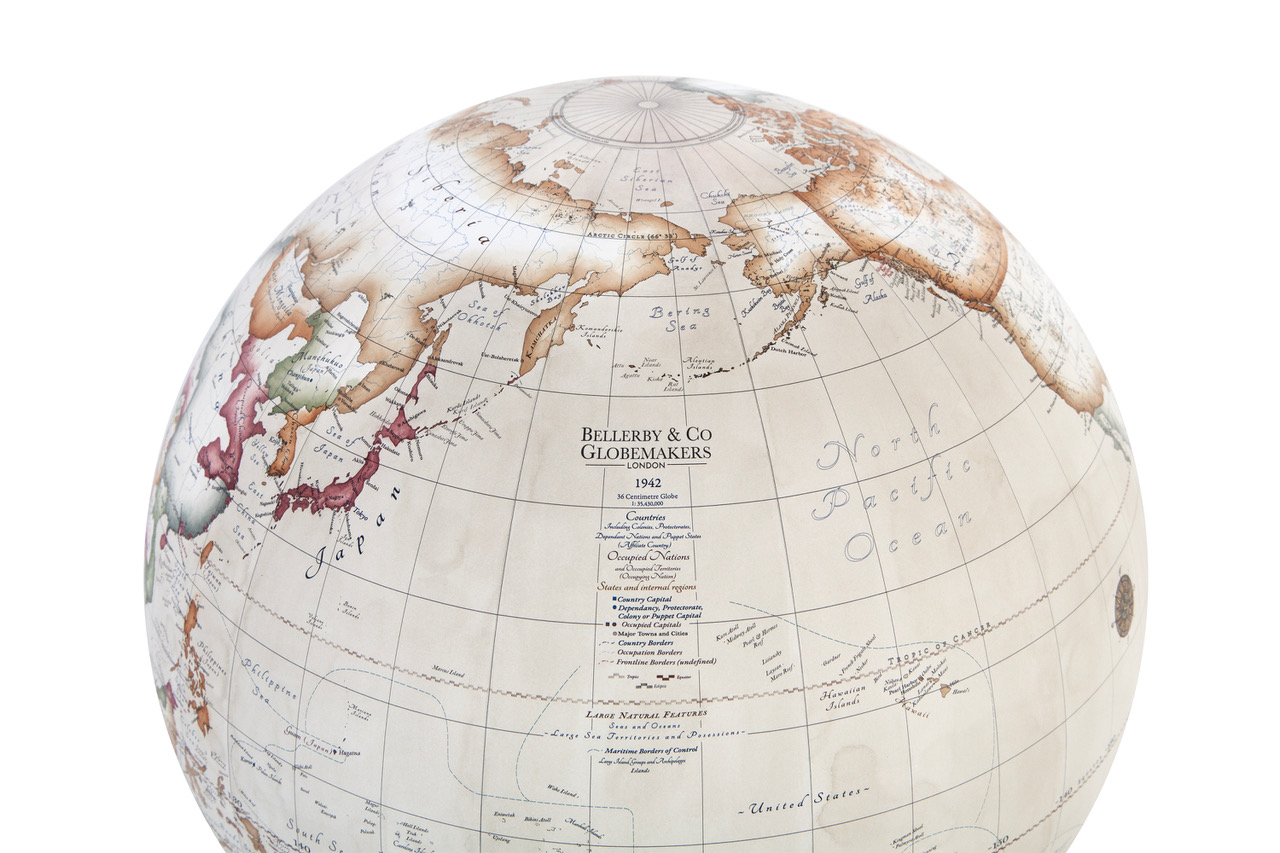
We love love loved this commission. We sourced a reference of a 1942 map and our talented cartographers created gores so the map projection would be an accurate map to be able to make a 36cm diameter globe. The commission was inspired by the clients visit with her son to Chartwell where the original inspiration for the sizing of our Churchill globe is – an interesting reference linked here on the conservation of this globe. The map reflects the borders during World War II which is fascinating to explore and think about.
In the early stages of World War II in the Pacific, Japan made steady gains against the Allies. In 1940, with the collapse of France in Europe, the new Vichy regime allows Japan to annex French Indochina. After the attack on Pearl Harbor, Japan proceeds to occupy Wake Island, the Philippines, British Malaya, the Dutch East Indies, northern New Guinea and a number of pacific islands. Also Japan begins attacks against British-held Burma and India, and creates a puppet regime in Burma. From 1943 to its defeat, Japan steadily loses territory in the Pacific to the Allies and in 1945, Japan surrenders, abolishing its remaining puppet regimes in Manchukuo and Mengjiang, and abandoning its hold on Korea.
Then World War II in Europe – of course many boundary changes occured as Axis powers and the Soviet Union re-divide the areas under their control. Scroll to the bottom of this post for all the changes between 1918 – 1942.
Click here for an article : 42 maps that explain World War II
The Parchment Cassini colouring suited the era of the map and design so well. The added personalisation is the hand painted compass rose and a few highlighted cities.




Continued from the top of this post and looking at European border changes.
.
The history of borders in Europe are fascinating .. going only as far back as 1918 – when Ukraine, Belarus, Poland, Latvia, Lithuania, Estonia, Georgia, Armenia and Azerbaijan declare their independence from the Russian Empire. Russia recognises the independence of Finland, declared in 1917. The Kingdom of Serbs, Croats, and Slovenes (later known as the Kingdom of Yugoslavia) is formed.
.
1919–20 — After the dissolution of Austria-Hungary, the fates of the successor states are decided by the Treaty of Saint-Germain and by the Treaty of Trianon. This results in Austria and Hungary with reduced borders, while Czechoslovakia is formed from their former territories. Other territories of the former monarchy are additionally awarded to Italy, Poland, Romania and the newly formed Kingdom of Serbs, Croats and Slovenes. In 1919, Germany suffered substantial territorial losses in the Treaty of Versailles. Belgium receives Neutral Moresnet and three German cantons as compensation for extensive damage during World War I. These three cantons still form the German-speaking community of Belgium: Eupen, Malmedy and Sankt Vith. Denmark receives Northern Schleswig from Germany (with local plebiscites concluding in 1920). Most of the Prussian provinces of Posen and of West Prussia go to Poland. The east part of Upper Silesia and the area of Soldau in East Prussia are annexed to Poland as well. Danzig and Saarland fall under the control of the League of Nations. The Memel territory comes under a temporary French administration.
.
1920 — Greece is promised most of eastern Thrace as well as Ionia with the city of İzmir (Smyrna) in the Treaty of Sèvres. Soviet Russia invades and occupies Azerbaijan. Soviet Russia recognises the independence of Georgia. Soviet Russia invades and occupies Armenia. The Free State of Fiume is established as a result of an Italo–Yugoslav border dispute.
.
1921 — As a result of winning a war against Soviet Russia, Poland gains territories east of the Curzon Line, inhabited essentially by Lithuanians, Belarusians, Poles, and Ukrainians. Soviet Russia then invades and occupies Georgia. The Treaty of Kars rearranges the borders in the South Caucasus, considerable territories of Georgia and Armenia are ceded to Turkey.
.
1922 — The Soviet Union is officially formed under the Treaty on the Creation of the USSR. In December, the Irish Free State and United Kingdom of Great Britain and Northern Ireland are formed from the United Kingdom of Great Britain and Ireland. The United Kingdom maintains Treaty Ports at Berehaven, Cobh, and Lough Swilly.
.
1923 — The Treaty of Sèvres is superseded by the Treaty of Lausanne under which Greece loses its earlier territorial gains and the borders of modern Turkey are established. Western Thrace is ceded by Bulgaria to Greece, a decision earlier agreed upon in the 1919 Treaty of Neuilly-sur-Seine. On the Baltic sea, Lithuania annexes the Memel territory without plebiscite. Italian military forces take control of the Greek island of Corfu.
.
1924 — The Treaty of Rome is concluded on January 27, ending the existence of the Free State of Fiume and the Italo–Yugoslav border dispute. The treaty assigns Fiume (Rijeka) to Italy and Sušak to Yugoslavia, with joint port administration. On March 16, Italy formally annexes Fiume.
.
1926 — Albania cedes territory to the Kingdom of Slovenes, Croats and Serbs.
.
1929 — Vatican City becomes independent after the signing of the Lateran Treaty with Italy.
.
1930 — Bouvet Island is located in the Subantarctic, and declared a Norwegian dependency after a dispute with the United Kingdom.
.
1934 — Erik the Red’s Land, located in the east of Greenland, is returned to Denmark. The area had been occupied by Norway since 1931, but Norway accepted that the Permanent Court of International Justice ruled against this.
.
1935 — The Territory of the Saar Basin is reunited with Germany following the 1935 plebiscite.All territories taken from Czechoslovakia by its neighbours in October 1938 (Munich Agreement) and March 1939
.
1938 — Austria is annexed by Nazi Germany in the Anschluss. The United Kingdom returns the Treaty Ports to Ireland as part of the Anglo-Irish Trade Agreement over several months during the year. The Munich Agreement on September 29 permits Germany to also annex the Sudetenland region of Czechoslovakia. The First Vienna Award on November 2 awards southern Slovakia and southern Subcarpathian Rus’ from Czechoslovakia to Hungary, while Poland independently annexes Trans-Olza (Těšín/Zaolzie) shortly after.German-occupied Europe at the height of the Axis conquests in 1942
.
1939 — The Memel territory is ceded to Nazi Germany by Lithuania under pressure from Berlin on March 23. The rest of the Czech lands is taken over by Nazi Germany: a German protectorate called Bohemia and Moravia is formed on the remaining Czech lands shortly after the proclamation of the Slovak Republic. The same day, Hungary occupies and annexes the remainder of Carpathian Ruthenia and by the Slovak–Hungarian War acquires further territories from Slovakia. On August 23, the Molotov–Ribbentrop Pact is signed. Nazi Germany invades Poland on September 1; the Soviet Union – on September 17, regaining territories lost in 1921 in the Polish–Soviet War, and a bit more.
.
www.bellerbyandco.com
Bellerby & Co Globemakers, London