People Magazine | October 2026
Bellerby & Co Globemakers in People Magazine!
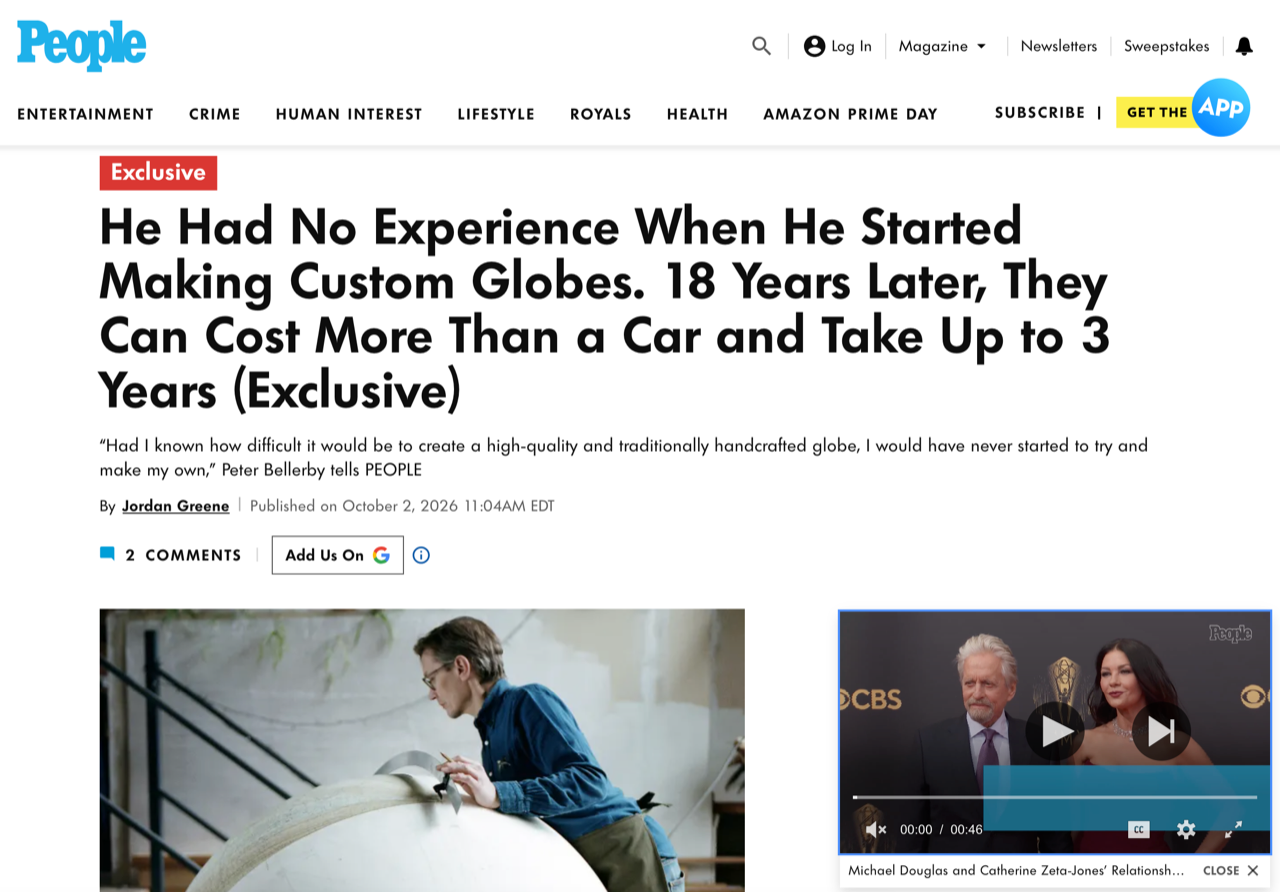
Long before Peter Bellerby learned how to make a globe, he was fascinated by how things were put together.
As a child, he was constantly taking apart his toys — and even a watch he had been given — to understand the engineering behind them. That curiosity eventually led him to develop an eclectic collection of hands-on skills, from watercolor painting and violin-making to woodworking and metalworking.
Bellerby also spent years renovating houses he purchased to resell, learning about materials and tools along the way. And during a long career in television, where he bought and sold distribution rights, his work took him around the world, deepening his fascination with maps while inspiring him to eventually leave his desk job and create something of his own.
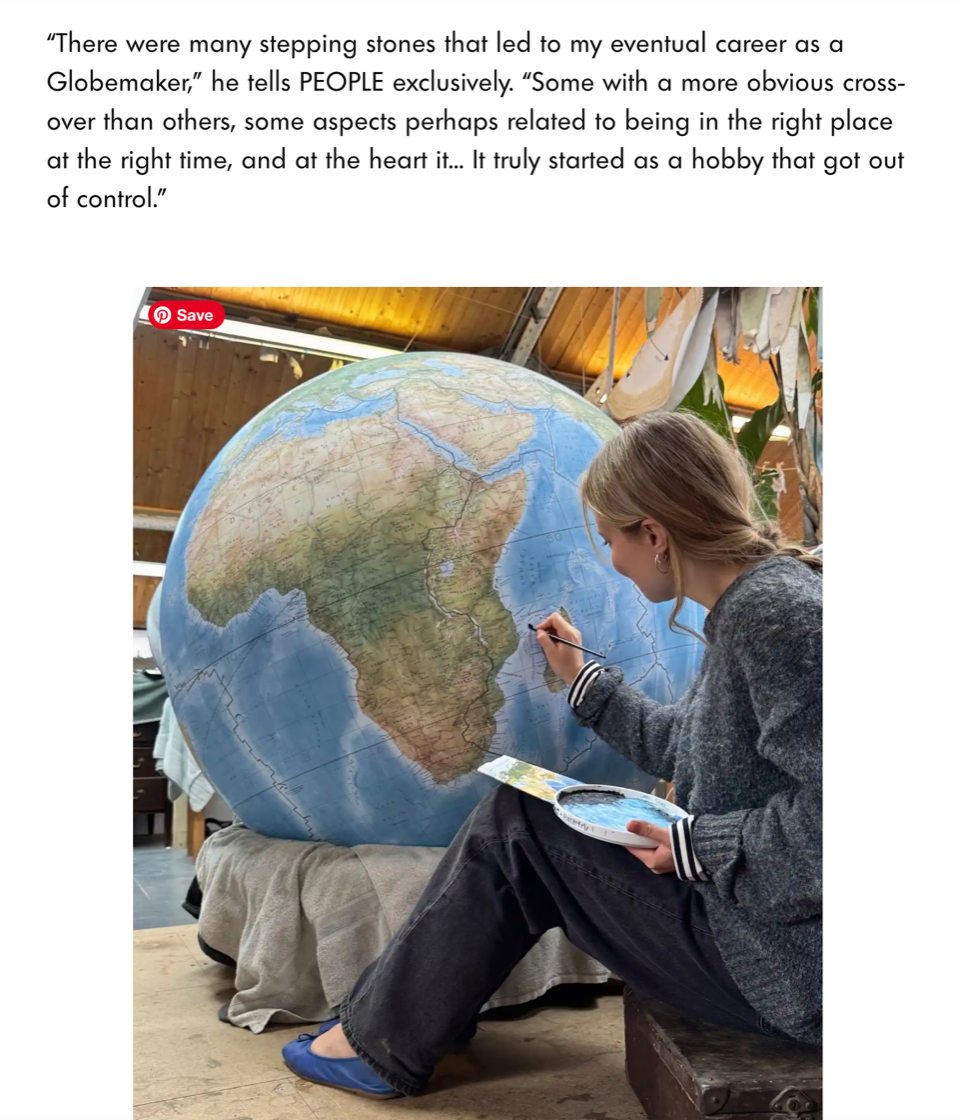
In 2008, that hobby became Bellerby & Co. Globemakers, the London-based company Bellerby founded and still runs today. The studio now employs as many as 35 people, producing handmade and hand-painted globes ranging from roughly 5 inches to 5 feet in diameter.
But Bellerby had no traditional apprenticeship to fall back on when he started.
“There is no manual and nowhere to learn to make globes, I taught myself and learned by trial and error,” he says. “I am still always learning new things 18 years on.”
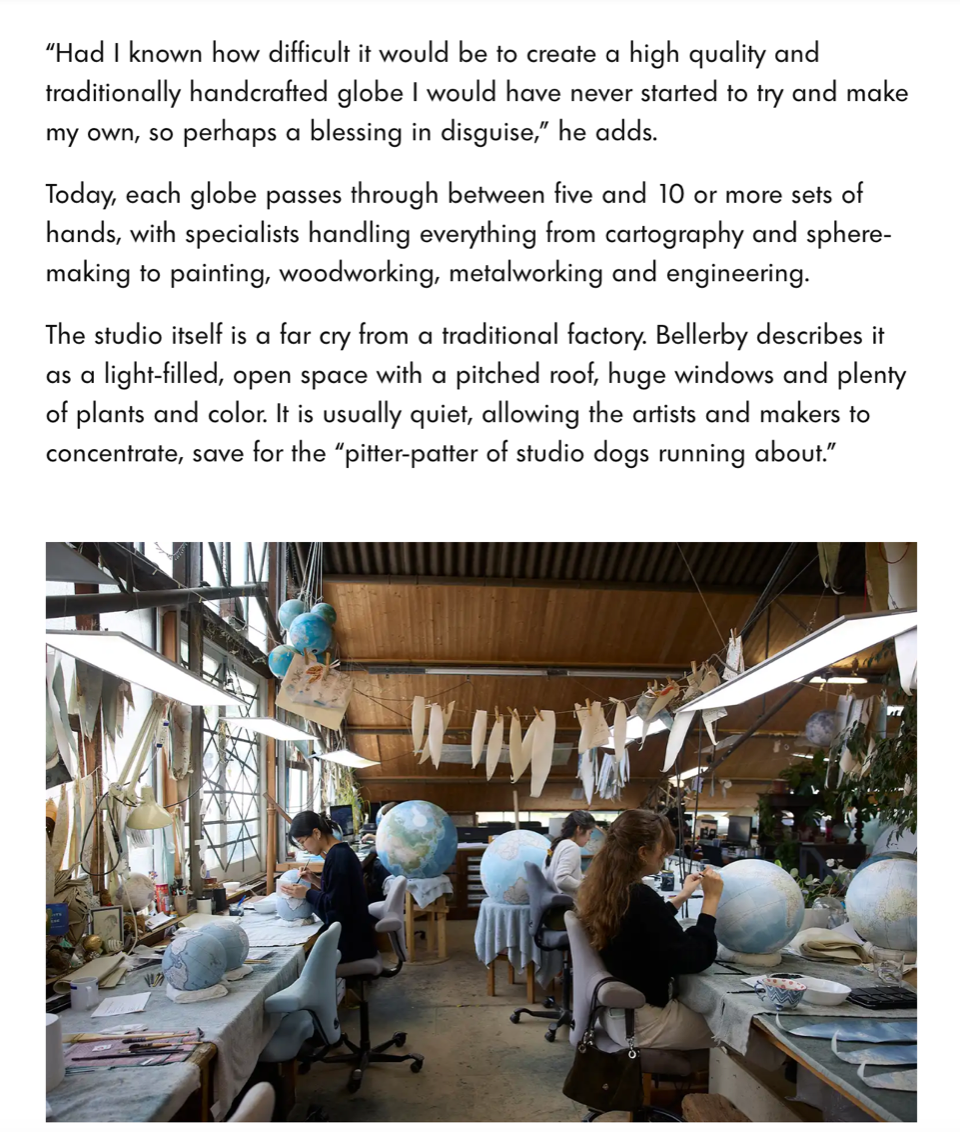
Since each globe can take anywhere from weeks to months — or even years — to complete, no two days are quite the same.
The process, however, always begins with the sphere itself. The team creates the globe using two half-molds, carefully working to ensure the finished sphere is correctly sized and balanced. From there, the cartographers begin creating the map.
“We have had clients share their diaries with 70 years of their travels which they want us to document through travel routes, labels, adding years and memories, adding illustrations etc.,” Bellerby says. “We have designed in years of family history across generations.”
Once the cartography is complete, the flat map has to be transformed into pieces that can fit around a sphere. The team does this by dividing it into “gores” — long, curved, pointed strips of paper that resemble orange slices or surfboards, with each piece containing a section of the world map.
“The sizing of the gores has to be exact, down to the millimeter, and when being cut with a scalpel requires an expert and practiced hand, as again the smallest mistake means the last piece will overlap or there will be a gap,” Bellerby says.
“You have to take into account how the paper wets and stretches and reacts to water, heat, cold,” he adds.
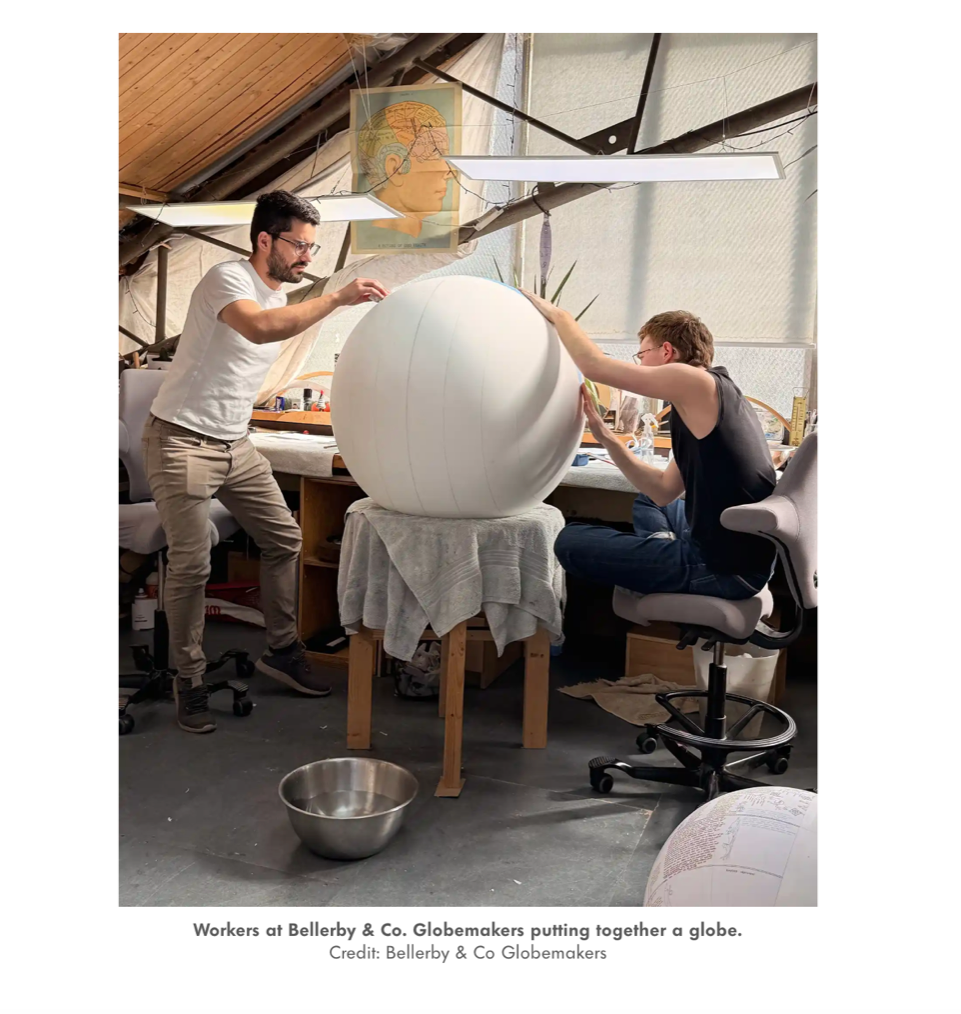
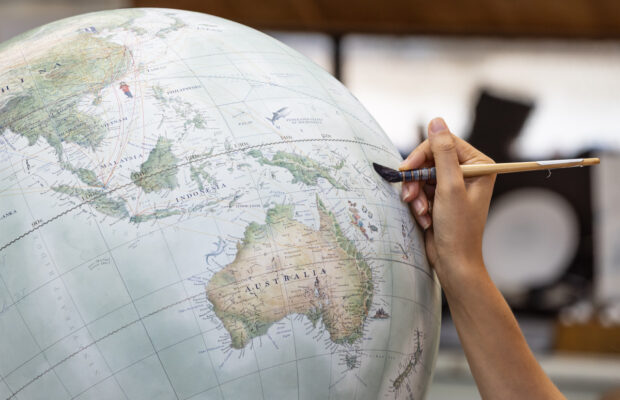
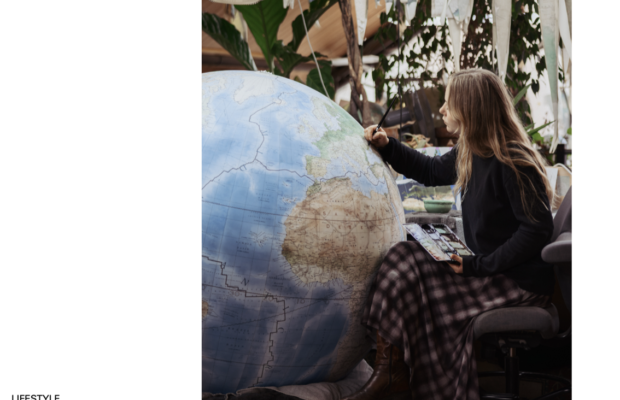
Once cut, the gores are painted by hand with watercolors. However, unlike a traditional watercolor painting, the finished pieces eventually have to conform to a three-dimensional surface.
“All watercolor artists have experience working on flat paper but need to learn the techniques and skills required to paint on a sphere without the pigments running,” Bellerby says.
After the painted gores are dry, they are ready to be attached to the sphere in a process known as “goring the globe.”
To do that, the paper is moistened and carefully stretched over the curved surface. The process requires a steady hand because the wet paper becomes extremely fragile.
“That stage is very precise work and very difficult because you’re wetting the paper and stretching it, wet paper as you can imagine is very fragile,” Bellerby says. “The paper wants to rip, ripple, bubble or tear naturally. If you work with one piece too long it will naturally degrade.”
Mastering the technique takes years of practice, Bellerby says, as makers learn to anticipate how the paper will move and respond.
“You develop the eye for detail, the movements, the feeling for the paper, the steady hand to cut the gores and manipulate the wet paper without it ripping, rippling, tearing, bubbling or turning into papier-mache,” he says.
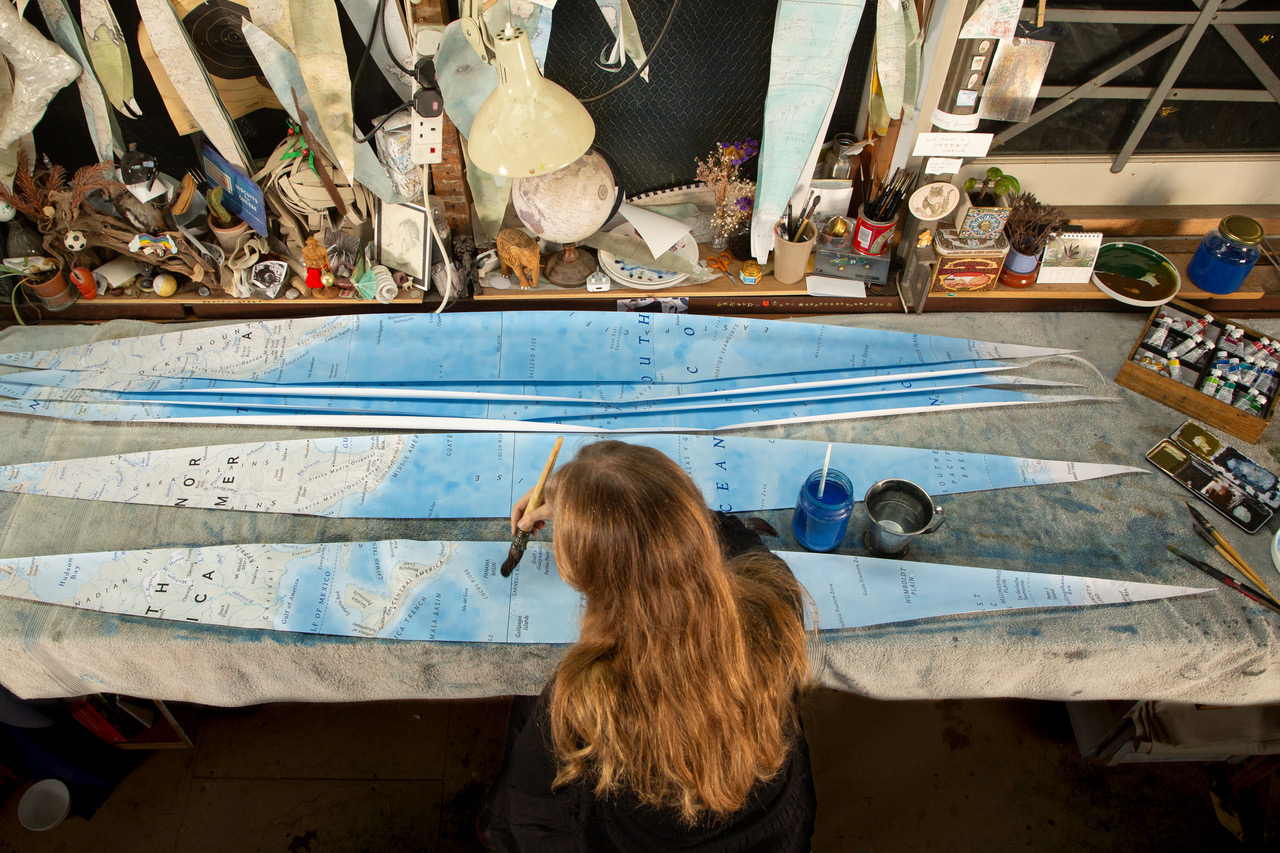
Once all the gores are in place, the globe receives additional layers of watercolor and detail before being sealed with either a gloss or matte finish. Only then does the team turn its attention to the base. They create both traditional and modern bases from wood and metal, with bespoke commissions requiring their own design, prototyping and testing.
Larger globes can also feature handcrafted and hand-engraved meridians, sometimes incorporating personalized messages alongside traditional numbering and markings.
“So many pieces need to come together for one globe,” Bellerby says. “We need to have many eyes on everything we do at many stages and there are endless ways one globe can go wrong whether that be with the cartographer, the maker, the painter or an aspect of the base.”
“Sometimes we have to indeed start over which is frustrating but a normal and expected thing with anything handcrafted and hand painted,” he adds.
Once a final inspection is complete, the globe is assembled with its base and engraving before being carefully packaged in either a bespoke flight case or specially made crate and shipped to its new home.
Some projects have taken three years from start to finish, much of that time spent working with the client on the design. The price of a globe reflects not only the size and materials but also the amount of time and labor involved.
“Pricing ranges from what someone might pay for an iPhone, to a designer bag, to a luxury watch, to a brand new car and beyond,” Bellerby says.
“Considering we can spend between a few weeks, to months, to years working on one commission, and we are creating everything here in London, there is a wide range of pricing that reflects our time, the materials and that our studio has highly skilled trained artisans and artists,” he says.
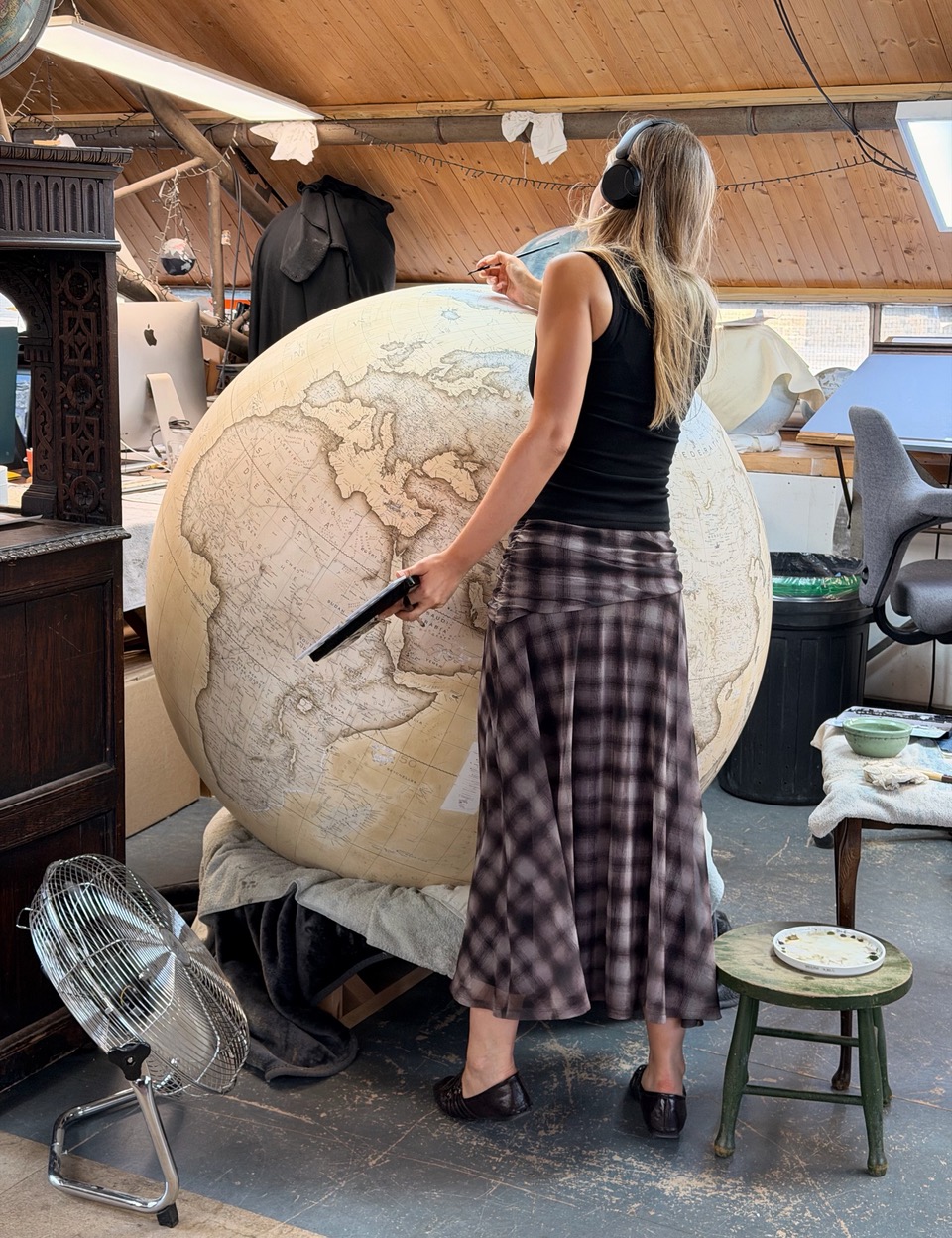
One of the most meticulous they completed was a globe created for the National Geographic Museum and headquarters in Washington, D.C. The project required careful coordination around the map, dimensions, base and coloring, leaving little room for error.
Members of the National Geographic team even traveled from the U.S. to London multiple times to inspect the globe as it progressed.
@globemakers
You go out a window and via the rooftop! . Adventures in the world of renting a cherry picker / forklift and transporting a very heavy and very valuable artwork. This globe is the largest globe we have ever made (152cm / 60 inch diameter), a commission now headed to Washington D.C., United States of America, soon to be announced where you will be able to see it. . Ahead of bank holiday weekend we raised a glass as a team to celebrate the many hands that went in to the creation of the globe, map, painting, base and everything in between to make this happen. Special shoutout to Kasia who had a very specific and tight / exacting brief and stared at this globe morning til night for months. . Wait til the end for an appearance by George our original and number one studio dog and our neighbour who came to the rescue with experience operating and driving this forklift thingy… . Bellerby & Co Globemakers London, England ~ We create traditionally handcrafted and hand painted globes and maps ~ bespoke, customised and personalised. Large and small. We ship worldwide. . #globetok #dayinthelifeofanartist #globemakers #mapart #stokenewingtonchurchstreet
♬ original sound – Red Mist
“We were just incredibly slow, thoughtful and careful with everything we did as the timeline provided no room for error,” Bellerby says.
“Luckily they were delighted with the progress each time!” he adds.
For Bellerby, the painstaking process has also created an unusual community of craftspeople. Many of the artists and makers who now work at the studio discovered the company through social media or came across a job posting and began researching the craft for themselves.
“They came to their interviews totally intrigued at realizing a job like this still exists today and just how much goes in to the creation of each globe,” Bellerby says.
After nearly two decades of making them, Bellerby still finds himself learning.
Perhaps that is fitting for someone whose fascination with globes began with a curiosity about how things work — and a lifelong willingness to take them apart and figure it out.
Looking at the finished pieces has also given him a different perspective on the world they depict.
“What a small place we occupy on this planet, it is a big wide world out there with a lot to discover, it is very humbling,” he says.
“Had I known how difficult it would be to create a high-quality and traditionally handcrafted globe, I would have never started to try and make my own,” Peter Bellerby tells PEOPLE
Published on October 2, 2026 11:04AM EDT


:max_bytes(150000):strip_icc():format(webp)/Jordan-Greene-9291a74b3bbf4ca7b534029f012979ce.jpg)