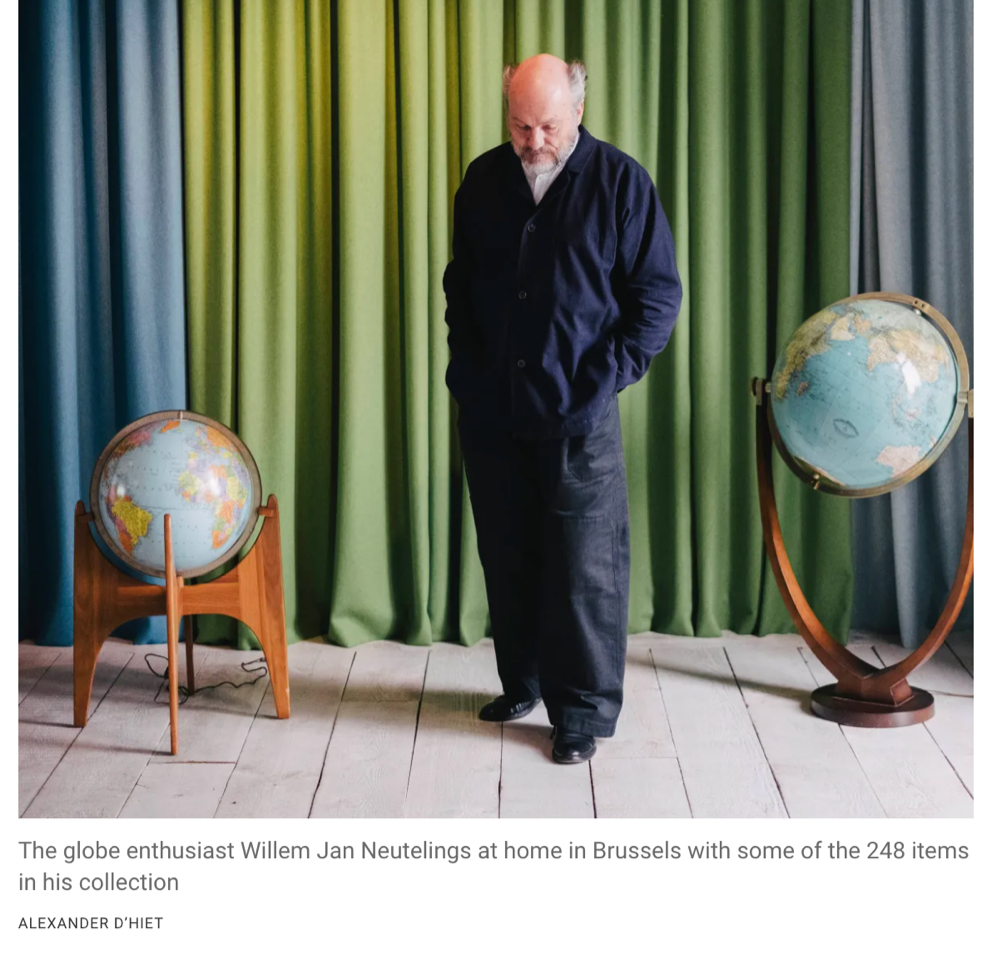
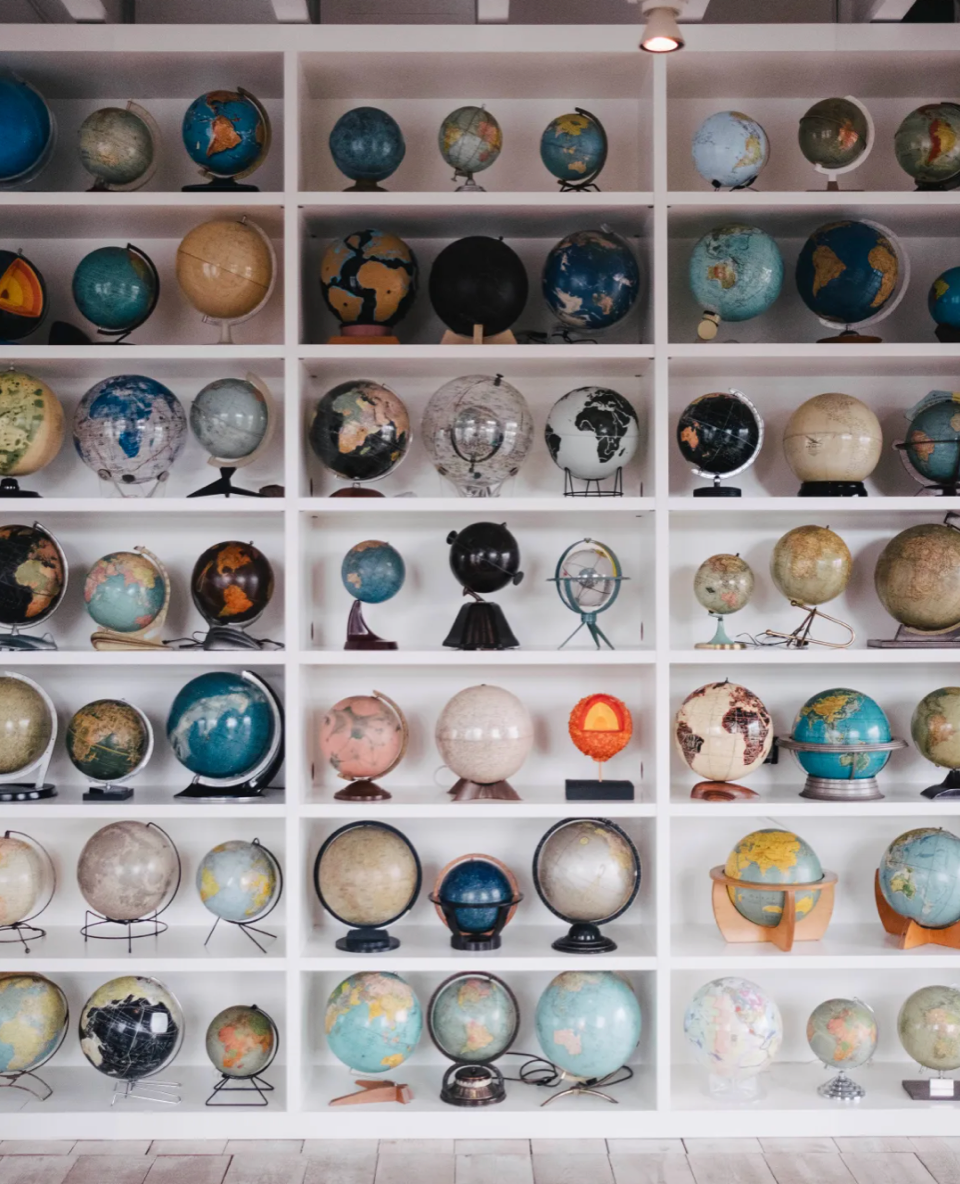
Lovely article mostly focusing on globe enthusiast Willem Jan Neutelings who had 248+ globes in his collection, which were in his Brussels home and now are in MAP – Musea Aan het Park Sint-Niklaas. His collection sounds so amazing, an electric illuminated globe from the 1920s, a plastic relief globe from the 1940s and an inflatable vinyl globe from the 1960s — each seen at the time as cutting-edge innovation. There are radio globes, clock globes, bookend globes, cigarette-lighter globes; a globe that’s a drinks cabinet; a wipe-clean slate globe, on which everything but the outlines of the continents has to be added with chalk; a semi-translucent globe with physical mapping on which political boundaries appear and disappear at the flick of a switch; a Braille globe; a talking globe (record player not included); and a globe that shows nothing but airports. And that’s before we get to the celestial, lunar, solar and Mars globes …
Neutelings highlights fast-changing aesthetic trends (art nouveau, art deco, streamline, modernist, psychedelic); the evolution of materials and technologies; the pushing back of scientific frontiers (tectonic, bathymetric, aeronautic, electronic); and the restless rhythms of political and social change. But his main point is simpler: “Each globe tells a story.”
You sense this as soon as you consider any globe. Who bought this, you wonder, and what happened next? You want to look more closely, to touch and spin, to trace real or imagined journeys. Then unexpectedly evocative details draw you in: old shipping routes; obsolete place names; oversized blocks of colour denoting long-lost empires. If you’re old enough to remember — well, this is how your world used to see itself. That’s the point, Neutelings says: “A globe is a mirror of its time.”
Favourite quotes from the article about globes and our company.
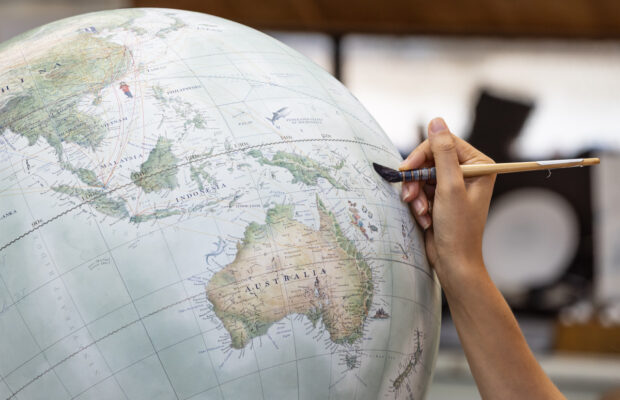
“Bellerby, a modest-mannered man just turning 60, discovered the craft in 2008. “My father was about to be 80, and I thought a globe might make a nice present.” But he couldn’t find one that pleased him. The mass-produced ones seemed garish and shoddy; the rare antique ones were unaffordable and “fragile to the point of unuseability”. So he decided to make one.”
“How difficult can it be to make a ball and put a map on it?” he asked himself. If he had known the answer he would never have started. Yet each messy setback fuelled his passion. His previous career in property development had stalled during the financial crisis, so he had the time and, initially, some savings. He poured it all into his grand project.
His father got his present two years late, but Bellerby by then had the beginnings of a business. By 2013 he had half a dozen people working for him and was selling 50 or 60 globes a year. Today he sells more than 500, helped by a team of over 20 specialists. His worldwide clientele includes billionaires, diplomats, film-makers, corporations and, he hints, several Arab leaders.
Bellerby globes range in diameter from 12cm to 127cm and cost anything from £1,540 to £120,000 or more, with no upper limit for bespoke globes. Each takes several months to make and there’s a long waiting list. “I’m still not sure that the business is viable,” he says. But rival globe makers give him credit for what Bissell-Thomas calls “a resurgence of appreciation for this most beautiful craft”.
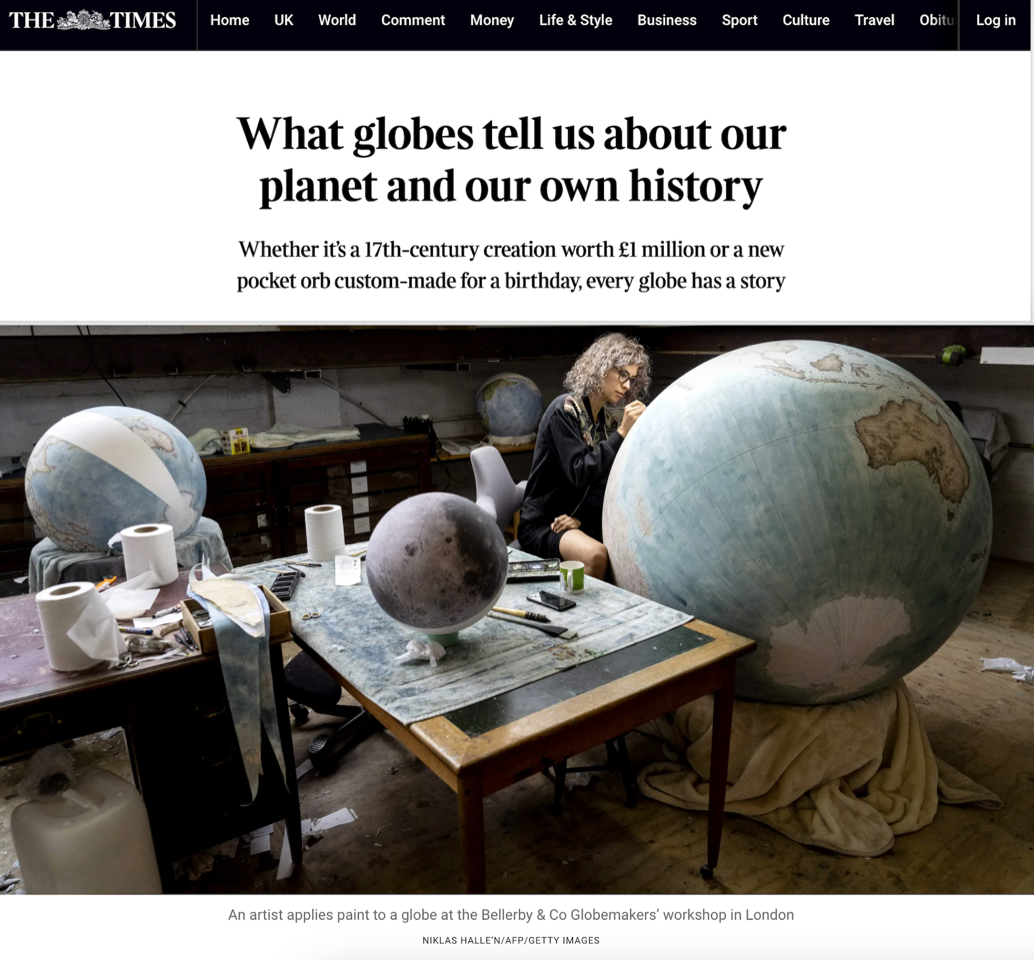
Bellerby’s spheres are made of resin these days, not plaster. But his approach remains mostly traditional, and his Stoke Newington studio is full of young, excited artists, barely daring to breathe as they apply wet brushes or sticky gores to half-finished globes. Clients choose from a range of basic styles (the Livingstone, the Albion, the Churchill, the Gagarin), but four out of five now want theirs further embellished with details of their own choosing. The German billionaire Reinhold Würth was given a Bellerby globe by his family in 2018 for his 83rd birthday, dotted and criss-crossed with extra details showing milestones and significant journeys in his life. His granddaughter Maria Würth called it “a symbol for his life and work achievements”.
Others have commissioned globes with key place names highlighted (or added), or with coats of arms, quirky illustrations of special moments, or favourite botanical, ornithological or technical themes. An ecologist bought one that shows the Earth as it was in the Ice Age; a telecommunications heavyweight went for undersea cables; and the family of the drummer Everett Morton own a Bellerby globe that doubles up as an urn for his ashes. “People tell amazing stories: family stories across generations,” Bellerby says. “If you think of a Jewish family moving from eastern Europe to western Europe to the United States …””
Loraine Rutt, the cartographer and artist says “There is nothing like a globe to make us really think about our place in the universe.”
“It’s about grounding,” she says. “And it’s about the power of touch. Geography is so instantly accessible on our phones that we take it for granted. But the physicality of a globe increases our understanding of our relationship with the planet.”
For today’s enthusiasts a globe tends to be a more intimate thing. Whether it’s a pocket globe from Rutt or a 4ft-diameter floor globe from Bellerby — or, for that matter, a priceless or facsimile antique globe — our response is likely to be reflective. A globe embodies not just our planet but our personal relationship with it, and often reminds us that our time on Earth is short. Where and how should we spend it? And by what traces would we like to be remembered?
“Google Maps can inform,” Bellerby says, “but it can’t inspire. Globes inspire people.” And that could be good news for Neutelings, because the digital mapping that ended his “golden age” seems, ironically, to have prompted a resurgence of interest in globes — even 20th-century ones — as objects to cherish.
Article by Richard Askwith