In a North London studio, the team at Bellerby & Co. is single-handedly reviving — and revolutionizing — the forgotten art of globemaking. By Darrell Hartman.
Like grand pianos, typewriters, and encyclopedia sets, globes are more often admired than used nowadays. Yet as Peter Bellerby notes, their emotional pull has intensified even as their practical value has waned. “Google Maps might inform, but a globe inspires,” Bellerby writes in his fascinating new book, Globemakers: The Curious Story of an Ancient Craft.
As the world’s most celebrated living artisan of handmade globes, Bellerby would know. His London-based Bellerby & Co. Globemakers produces hundreds of these prized pieces each year for an ever-growing clientele of affluent travelers and armchair navigators. Base prices (excluding customizations) range from $1,500 for a five-inch “pocket” globe to $85,000 for a 50-inch “Churchill” model with a six-legged walnut base. Nearly all Bellerby globes are built to order. Wait times can stretch up to a year.
Lest you think really?, consider the allure of a globe: You hold the planet in your palm; it spins and gets big ideas rolling. A beautifully crafted globe is a plaything with gravitas, a symbol of earthly knowledge. It harks back to an age in which scholars, explorers, and artisans made the world go round.
Multiple disasters and tens of thousands of dollars in sunk costs soon had him thinking otherwise. Though he had restored a vintage Aston Martin and terrace houses, Bellerby soon learned this self-taught hobby would be different. Spheres, it turns out, are aggravating shapes to work with. YouTube tutorials and knowledgeable tradespeople were scant. Modern printing techniques made some steps of the production easier, but so-called manuscript globes — the artisanal style made possible some 500 years ago with the advent of the printing press — require strips of wetted paper to be laid onto a perfect sphere; the mold and paper manufacturers he consulted with about this process were baffled. Bellerby’s early experiments with plaster of Paris brought “Saharan” quantities of dust into his living room and later got him evicted from his first studio.
Bellerby is soft-spoken, with a boyish flop of brown hair, and far more stubborn than his delicate looks suggest. Even after he’d switched to resin and glass-reinforced plastic for his globes, achieving perfection took all the manual dexterity and “bloody-mindedness” he could muster. He’d already decided to turn his globemaking into a business at this point, if only to salvage the two years and more than $100,000 he’d spent on it. His father received his 80th-birthday gift at age 82. “My mother cajoled him into saying thank you,” says Bellerby.
Though mapmaking dates to antiquity — the first realistic one was created by Ptolemy, the inventor of geography, in the second century A.D. — globes are thought to have come along during the Renaissance. The oldest surviving example is from 1492 and German. It features blueberry-colored seas, illustrations of enthroned kings and mermaids, several nonexistent Atlantic islands, and a vastly oversize Japan. Columbus had not come back yet, so the New World is not on it.
The first printed globes were produced in 1507 by Martin Waldseemüller, the German geographer who is also credited for creating the first wall map of Europe and dubbing the New World “America.” The art of globemaking flourished during the Age of Discovery, as the Western map of the world expanded rapidly. European merchants used terrestrial globes to plot their next shipments; navigators relied on celestial globes to deliver them. Many of the most beautiful antiques date to the 17th century, when rival makers in Amsterdam — including Willem Blaeu, the craft’s Michelangelo — strove to outdo one another with larger and more elaborate showpieces. These premodern globes grew up to 27 inches in diameter; they bulged with artistic and geographic detail, and eventually evolved as status symbols.
Industrialization and mass production turned globes into relatively cheap consumer products; in the 20th century they became schoolroom props, then objects of nostalgia and novelty. The globe that Bellerby remembers begging his parents for in the 1970s was designed for storing booze.
Having picked up the lost art of globemaking, Bellerby struggled to turn his new skill into a business. He sold his painstakingly restored Aston Martin DB6 to bring in much-needed capital. There were moments of serendipity: A curious neighbor came by his studio one day and offered to supply a house font. The neighbor turned out to be James Mosley, a world authority on historical typography — a bit like shooting an indie movie in the East Village and having Philip Glass wander by the set and propose to score it for you.
High-profile clients placed orders as word of Bellerby’s operation spread. The British-Nigerian artist Yinka Shonibare commissioned five globes for his sculptures, and “a former 007” (Bellerby won’t say which) asked for one — with three days to deliver. Bellerby scrambled and met the deadline. The company turned a corner when his life partner, Jade Fenster, took over marketing and publicity.
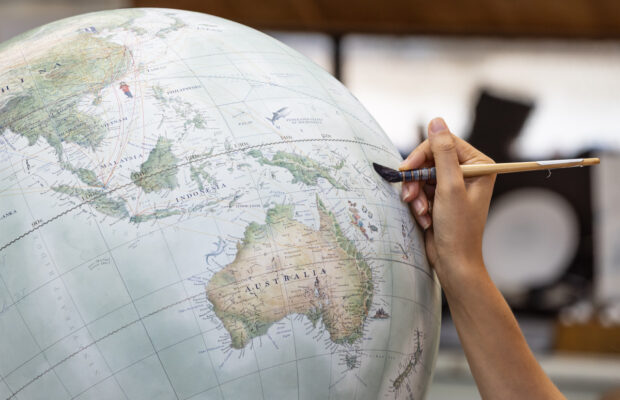
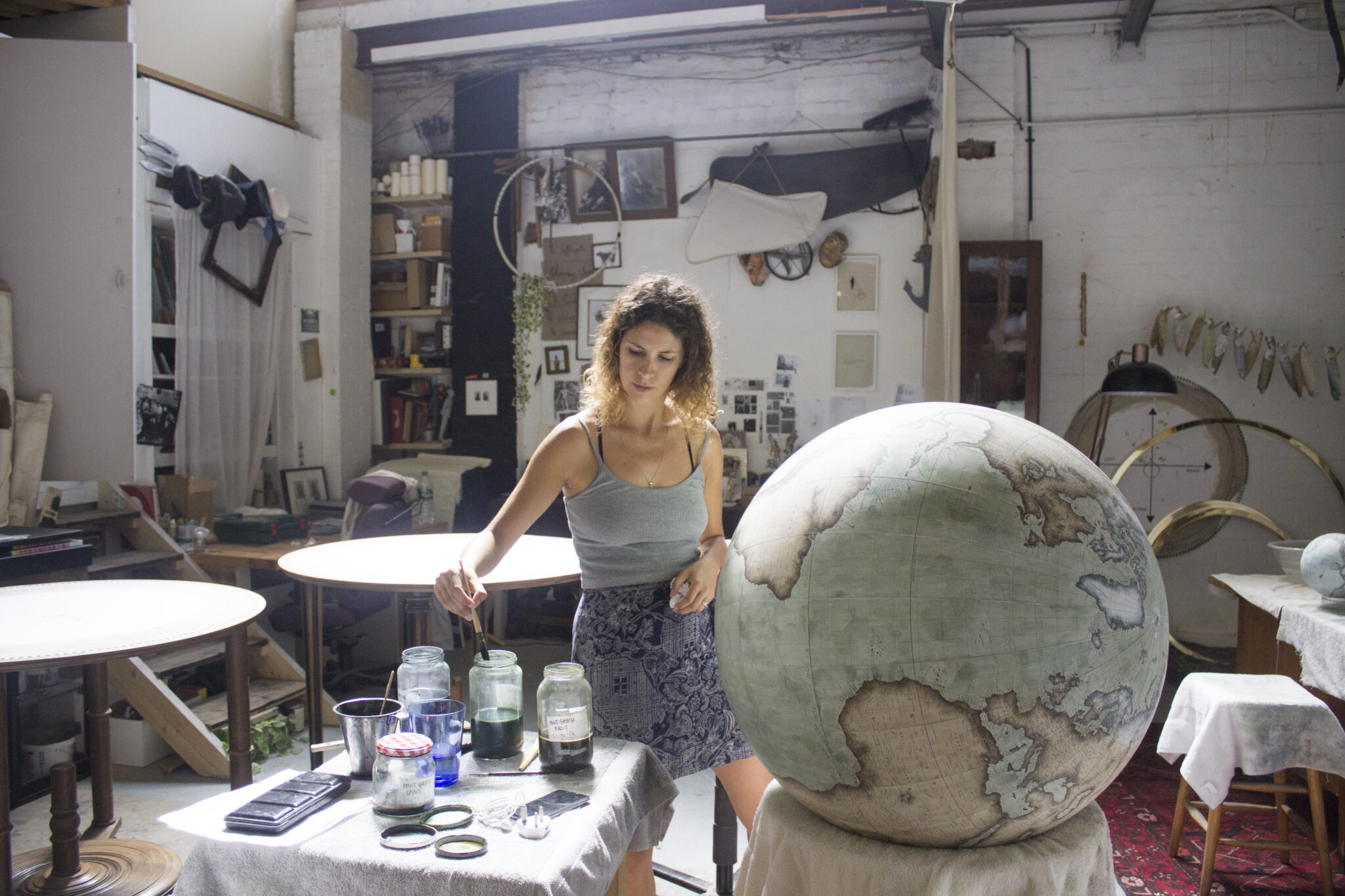
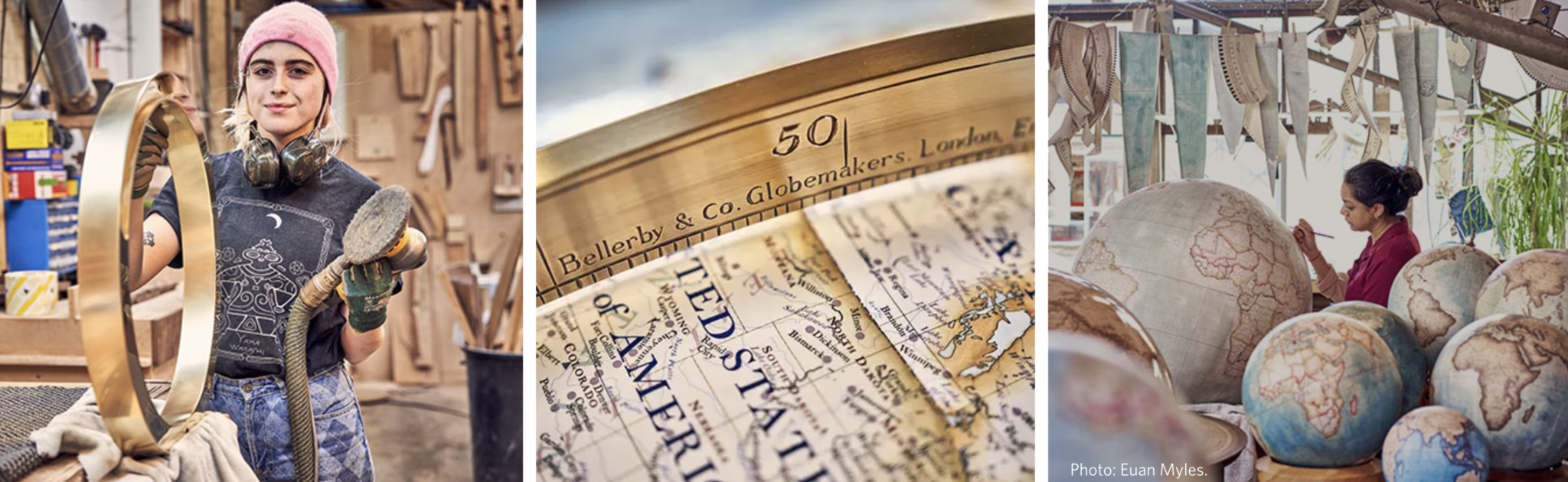
Bellerby now oversees 30 employees at his atelier in Stoke Newington, North London, which produces some 600 globes a year. Woodworkers craft stands; metalworkers make custom pedestals and hand-engraved brass meridians; painters apply the washes of watercolor that lend Bellerby globes their distinctive patina.
If there’s one thing keeping other high-end globemakers from emerging, it’s the difficulty of cutting and applying tapering slices of paper onto the sphere. [See sidebar.] Called “goring,” this specialized skill can only be learned on the job and takes a year or more to master. Fidgety types need not apply. Two of Bellerby’s gorers previously worked in decorative miniatures; one takes cold showers to give his breathing and hands the required steadiness.
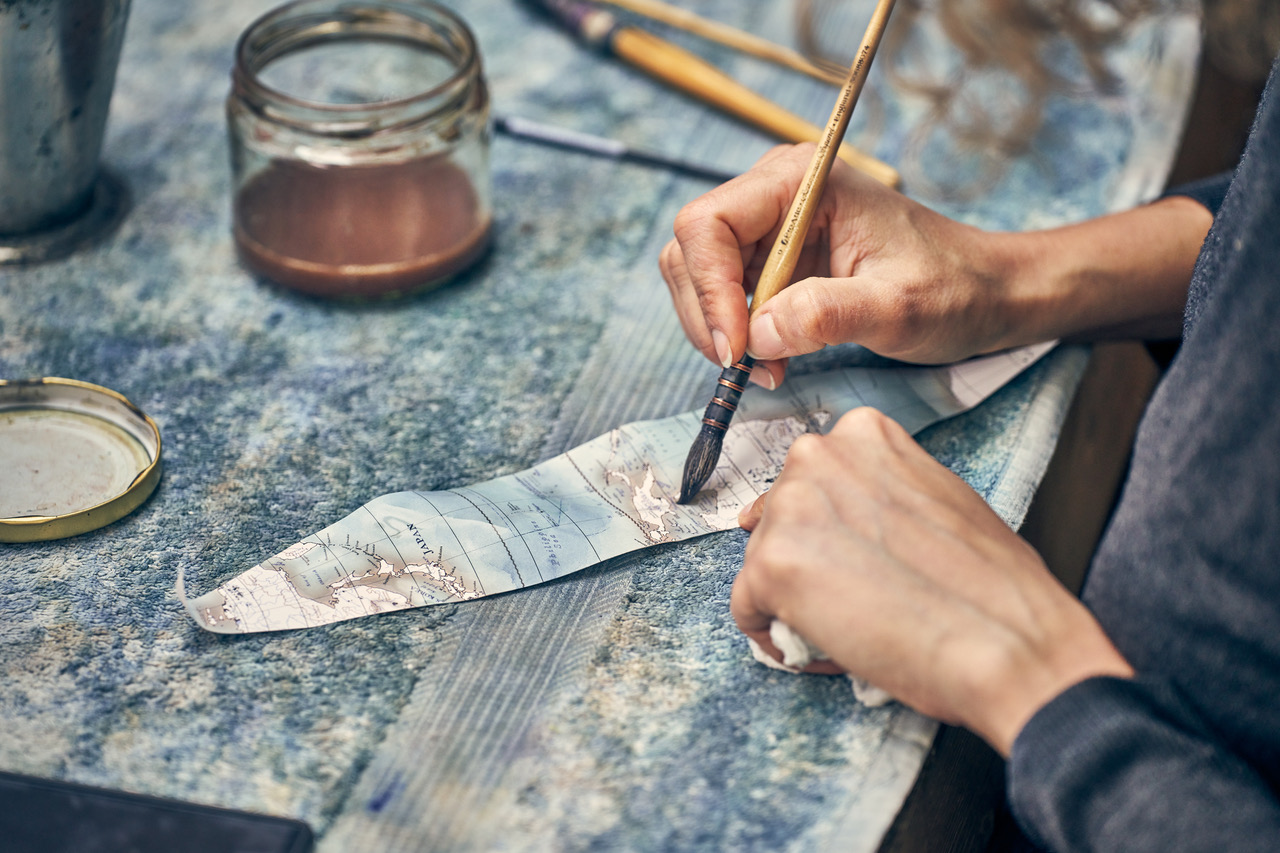
For many customers, the globes that resonate the most are highly personalized. Clients have had Bellerby globes denote wedding sites, personal travels, and ancestral migration routes. If you want yours to show the world’s undersea cable network, Bellerby can do that. Significant dates and favorite quotes can be inscribed. One client commissioned hand-drawn illustrations of four of his dogs flying biplanes.
As far as the cartography goes, the world is yours up to a point. Fictional worlds are fair game, but fictional maps are not offered (although when it comes to disputed political boundaries, Bellerby defers to the country to which the globe is being shipped). He’s not averse to bumps — he’s made a globe in braille — but he won’t raise mountain ranges, on the grounds that those topographic features violate the laws of scale. “It’s got to work,” he says.
Getting a globe to spin just right is all about nailing the equal distribution of weight, Bellerby says, a process he likens to tire-balancing. His globes make an oceanic sound as they rotate on their roller bearings. The Churchill spins for a full minute — two, if you really put your back into it. “It’s majestic, it really is,” he says.
The Churchill is billed as the largest commissionable handmade globe on earth. Bellerby has made 25 of them so far and plans to stop at 40. Similarly, he says that he would cap production at 1,000 globes a year. His attitude is that scarcity makes a thing special, and that — contrary to what many claim — luxury is worth waiting for. “Maybe, in fact, people want to spend more time on one product that will resonate for the rest of their lives,” Bellerby says, cracking a smile. “They don’t need to get it immediately.” 
How to Make a Globe
Illustrations by Joe McKendry
1. THE SPHERE
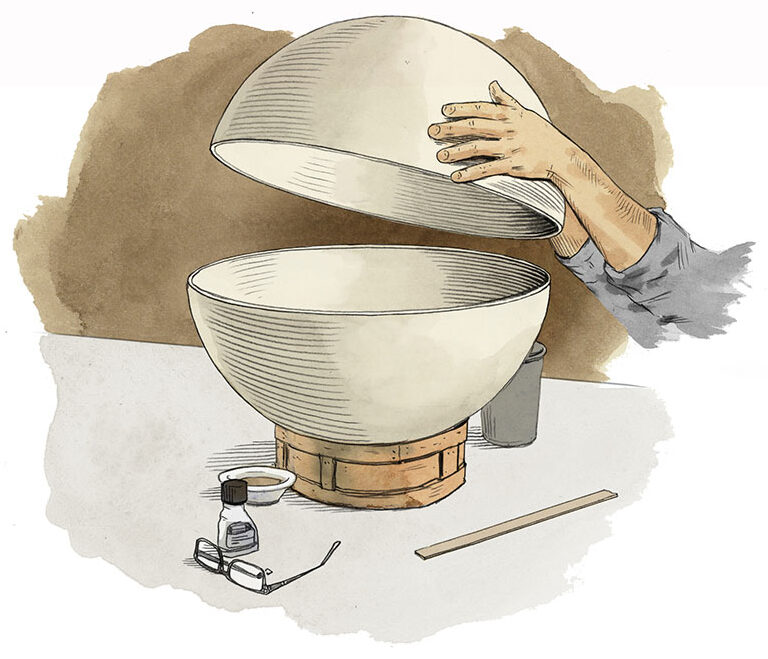
Bellerby’s globes are perfect spheres of fiberglass or resin. Two hemispheres are created using a custom mould, then joined.
2. MAPMAKING
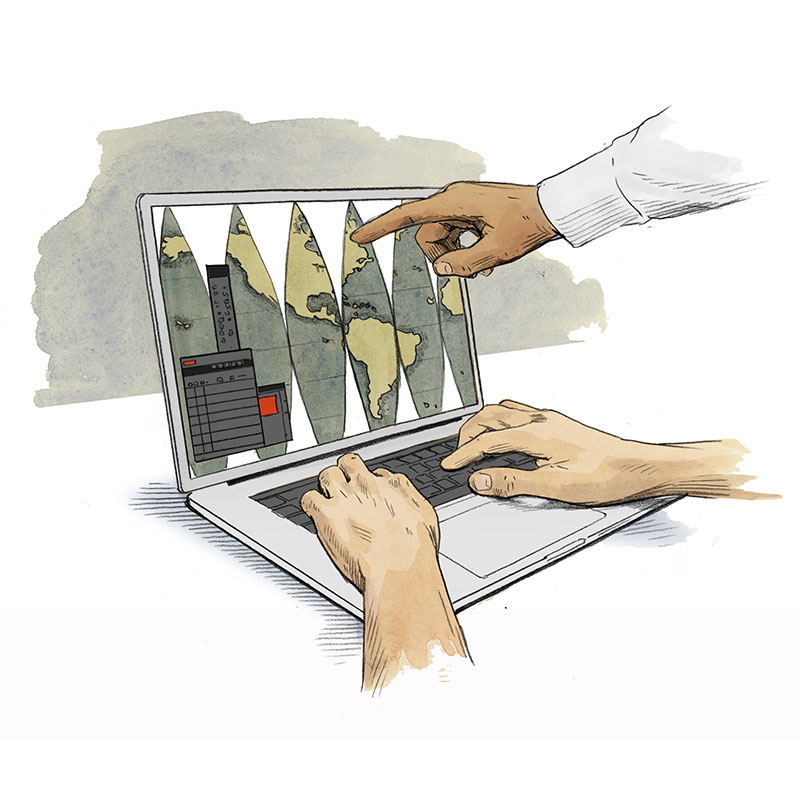
Three full-time cartographers ensure that the in-house digital map reflects the most current geography: the shrinking of the Aral Sea, the renaming of Swaziland to Eswatini. With software, the cartographers morph the maps into surfboard-shaped panels called gores. Once the design is complete, they’re printed.
3. GORING
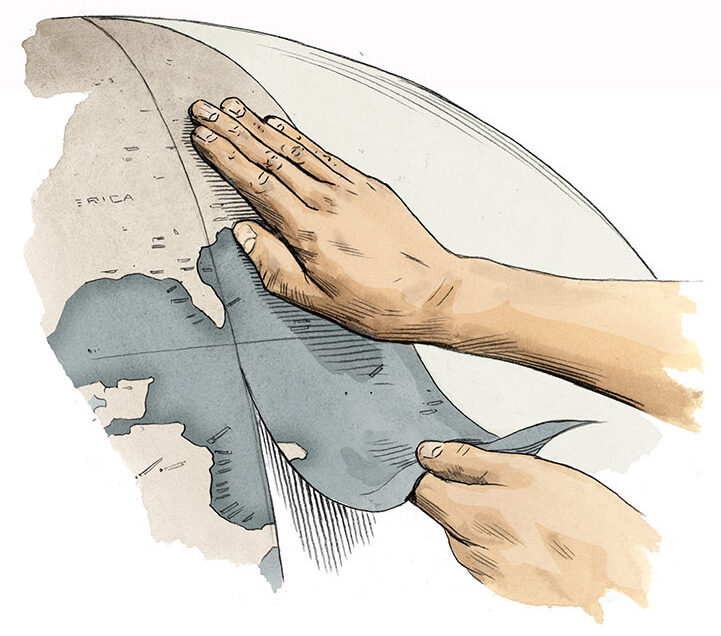
Using a scalpel, the globemaker cuts the gores expertly, then wets them and carefully stretches them across the sphere by hand. The maker must be careful not to wrinkle, bubble, or tear the delicate paper gores as they’re being applied. The tiniest error can make it necessary to start over.
4. PAINTING
Some watercolor washes are applied to the flat gores, but most of the hand-painting is done after they’re on the globe; a typical globe uses 30 different shades of pigment. The globe is then finished with a resin seal and a matte or gloss finish.
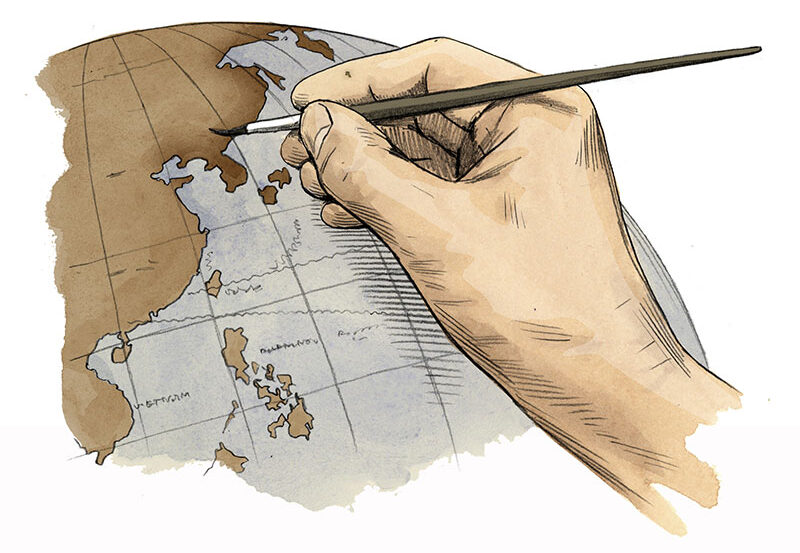
5. THE BASE AND MERIDIAN
Bellerby’s woodworkers craft bases out of oak, walnut, London plane, and other woods. (Bases of stone and metal are also available, including a stainless-steel option designed for yachts.) Most bases for the floor globes, which are larger, have a circular open tabletop with hand-turned legs and a hand-engraved bronze meridian.
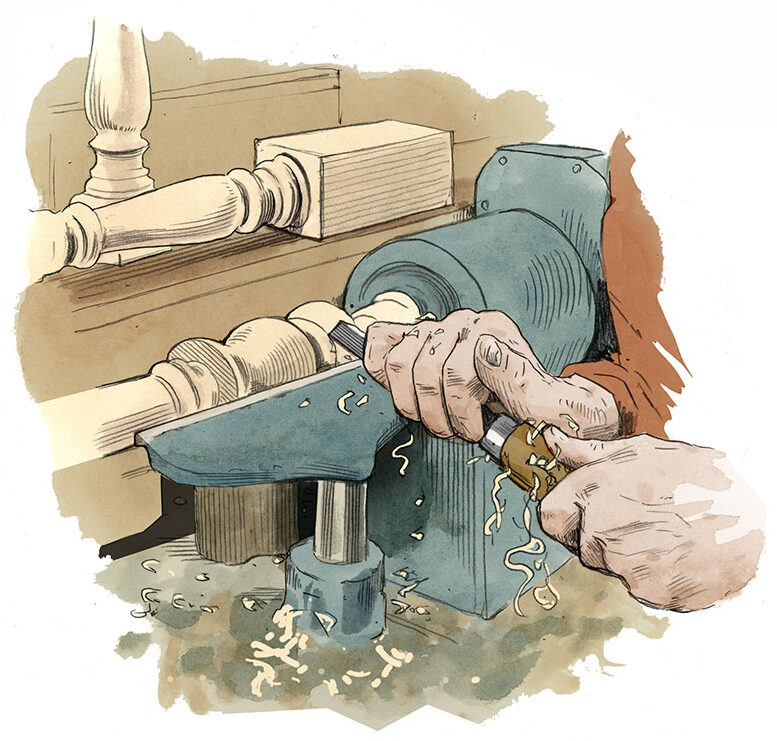
6. FITTING AND SHIPPING
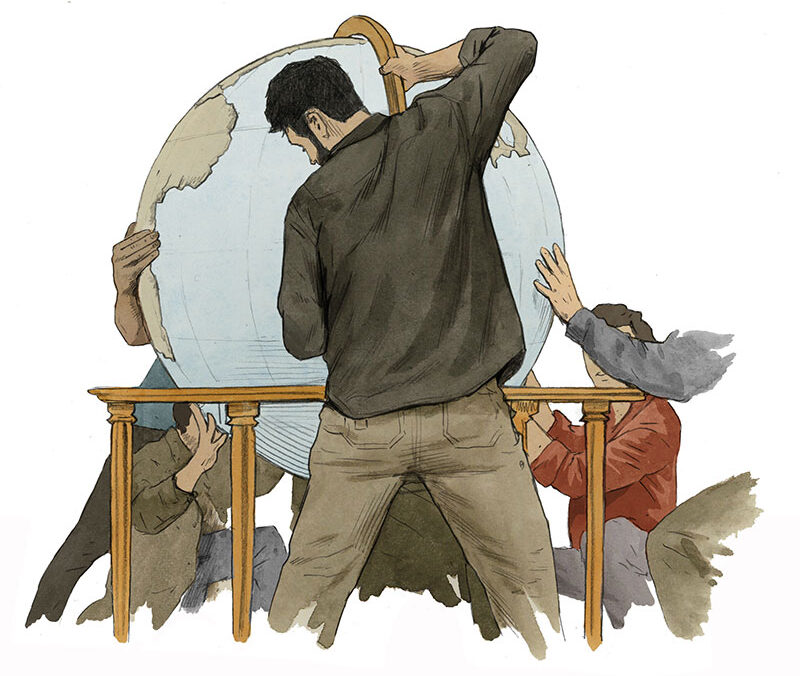
The globe is fitted into its base — for the Churchill, it takes 10 people — before being spin-tested and subjected to other quality checks. It’s then shipped in either a bespoke flight case or a sturdy, handcrafted crate, depending on the globe’s size.