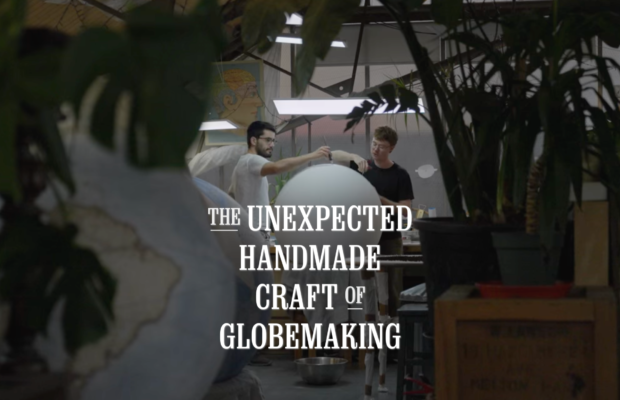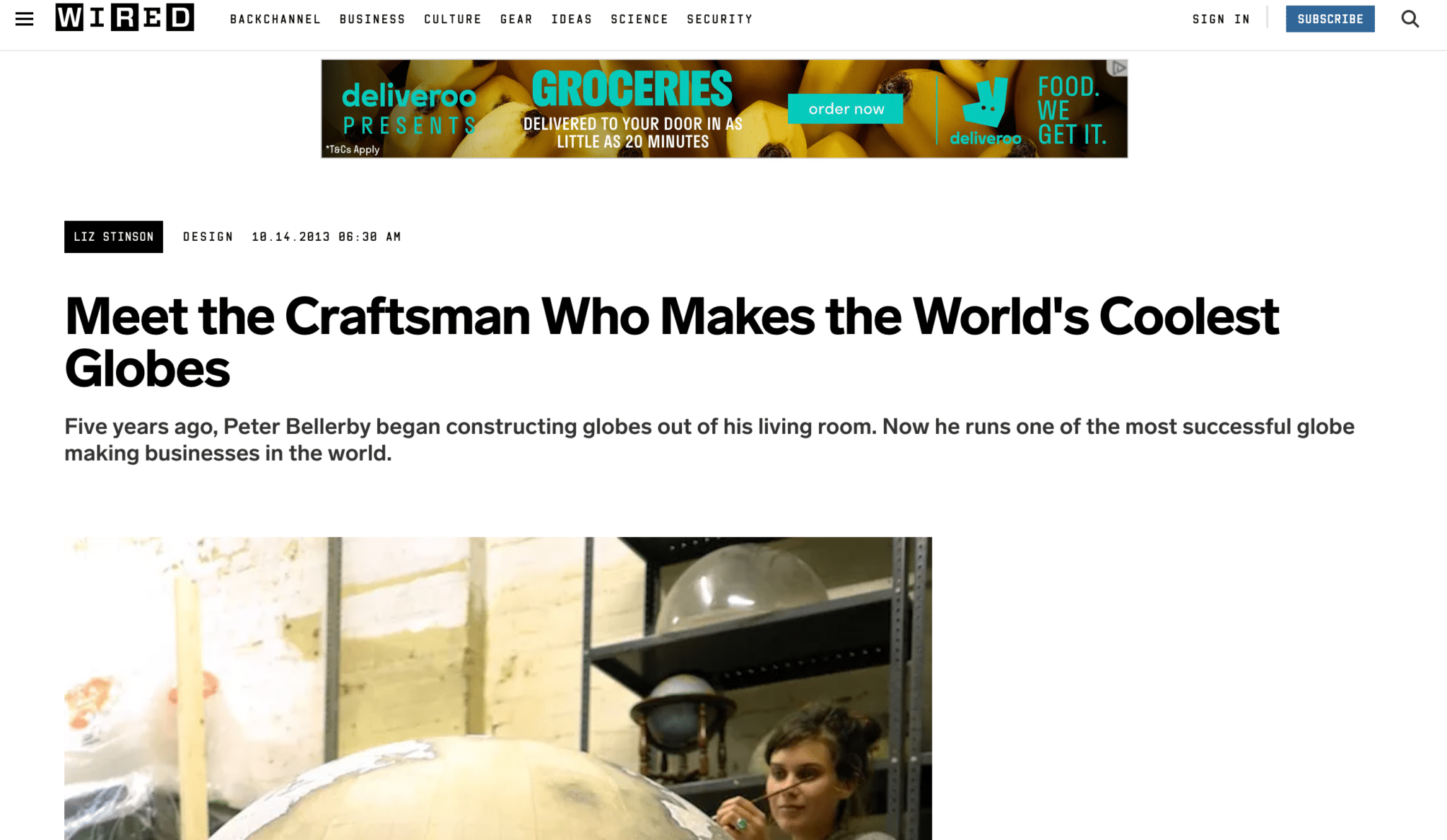
Back in 2008, Bellerby began constructing globes out of his house, curtaining off his dining and sitting rooms with plastic so they’d be protected from the casting process. He quickly learned that hand making globes requires some intensely technical skills that are equal parts reliant on perfect math and artistic execution. To begin, Bellerby had to learn how to mould a sphere— a process he describes as “really really difficult.” When he started, Bellerby threw out tens of thousands of pounds of incorrectly size moulds because in his eyes they just weren’t good enough. He explains that the whole process of making a sphere is fraught with issues, mainly because of the shape’s inherent nature. Basically, he says, “you’re multiplying every error by Pi,” which means one little tolerance can turn into a huge problem. Today, Bellerby uses Formula 1 fabricators to build the moulds, which helps him achieve his exacting standards.
Shaping the sphere is only the first part of the equation. After you’ve got that down, there’s a whole new set of challenges. Perhaps the most difficult part of globe making is applying the pieces of map to the globe shape. First Bellerby had to create a program that translated a rectangular map into gore, the triangular strips that fit onto a globe. And the goring process itself, as its called, requires intense concentration (they often work in total silence) to ensure that the pieces line up perfectly. “The map has to be stretched into place while wet and extremely fragile, and it is a case of learning how to use your hands in a very delicate manner,” he explains. “Every movement has to be in slow motion for fear of damaging the paper.” Bellerby’s biggest pet peeve is unaligned latitudes. “My personal bugbear is that makers think its fine to have latitude lines not aligned, sometimes not curved, and even at times the gores overlapping so much that countries get smaller or disappear,” he says.
As you might imagine, that imperfection doesn’t fly at Bellerby & Co. The globe maker says it took him 18 months to perfect his goring technique, and because of that he prefers to keep the details under wraps. “Most of fine details I don’t really tell anyone, as it took so long for me to learn,” he says. “We don’t even apply for patents or copyrights because that would just give the methods away.” Fair enough. The level of detail and precision on each globe really is astonishing, and the fact that it’s all done by hand—yes, everything is drawn and painted by him and his team—only adds to the globes’ mystique. It’s a lot of effort, he says, but ensuring that he produces a quality product is worth it. “The driver for me was that so many globes made in the past have fallen apart due to the difficulty in making globes,” he says. “And I want ours to be around for centuries.”