The Harmonia Macrocosmica is a star atlas written by Andreas Cellarius and published in 1660 by Johannes Janssonius. The first part of the atlas contains copper plate prints depicting the world systems of Claudius Ptolemy, Nicolaus Copernicus and Tycho Brahe. At the end are star maps of the classical and Christian constellations, the latter ones as introduced by Julius Schiller in his Coelum stellatum christianum of 1627.
Scenography of the Copernican world system

The location of the Earth encircled by the celestial circles

The hemisphere of the Old World, with its (climate) zones, (meridian) circles and the dwelling places of the distinctive races

The (astrological) aspects, such as opposition, conjunction, etc., among the planets

The (apparent) spiral revolution of the Sun around the Earth

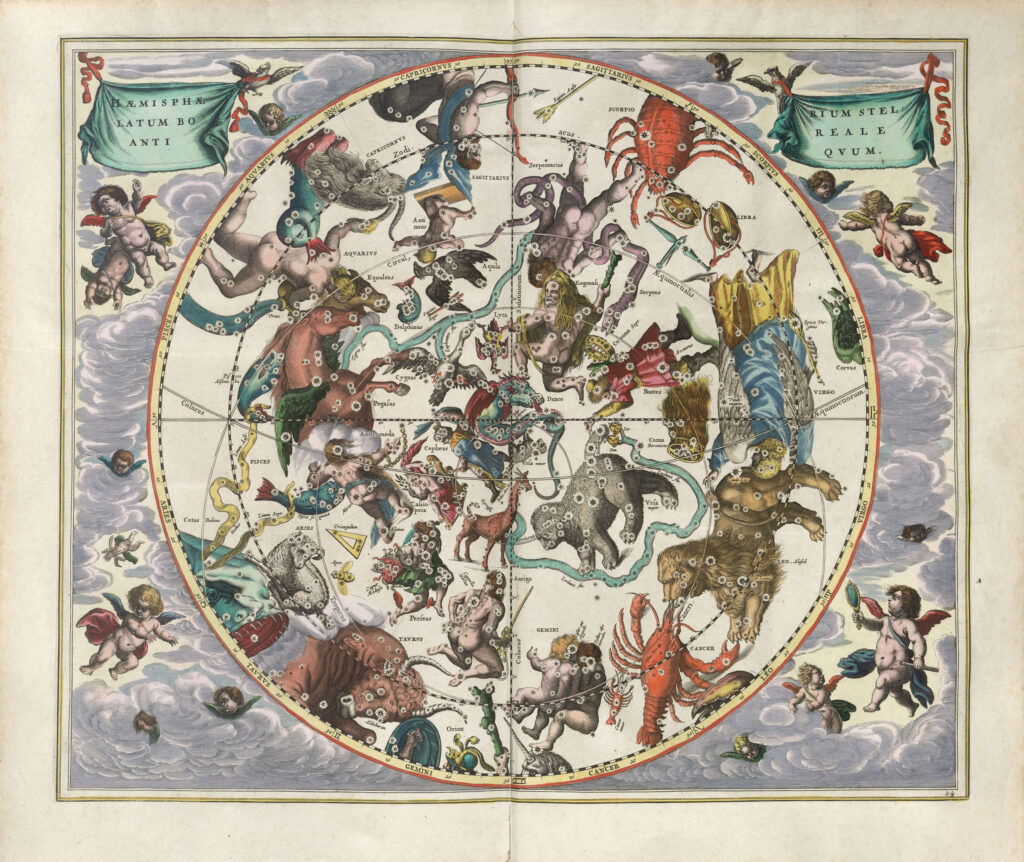
Spherical scenography of both the celestial and terrestrial northern hemispheres

*In general, the plates of the 1660/61 editions are coloured in bright tones – those of the 1708 reprint tend to be more plain in colouring.
*Info via staff.science.uu.nl –
In the foreword to his Chronologica, Gerard Mercator stated the intention to publish an atlas which would cover everything of the then-known cosmos, geography and history of the earth. During his life, Mercator published five volumes of his atlas, the last one being published by his son Rumold. After Mercator’s death, the Amsterdam cartographer Johannes Janssonius took over the project. He and fellow-cartographer Hendricus Hondius published their Novus Atlas in 1636, which featured over 320 maps in four languages. In 1660, Andreas Cellarius’Harmonia Macrocosmica was published as the seventh volume of the project. With the final addition of a volume describing the cities of the world from 1657, the project was finally completed.
Of the various engravers and authors who worked on the plates of the atlas, only two have signed their work. The frontispiece of the atlas was created by Frederik Hendrik van den Hove and ten other plates were engraved by Johannes van Loon. Moreover, all the designs of the classical constellations were taken from the ones created by Jan Pieterszoon Saenredam.
—
Celestial Spheres…
In astronomy and navigation, the celestial sphere is an imaginary sphere of arbitrarily large radius, concentric with a particular celestial body. All objects in the observer’s sky can be thought of as projected upon the inside surface of the celestial sphere, as if it were the underside of a dome or a hemispherical screen. The celestial sphere is a practical tool for spherical astronomy, allowing observers to plot positions of objects in the sky when their distances are unknown or unimportant.
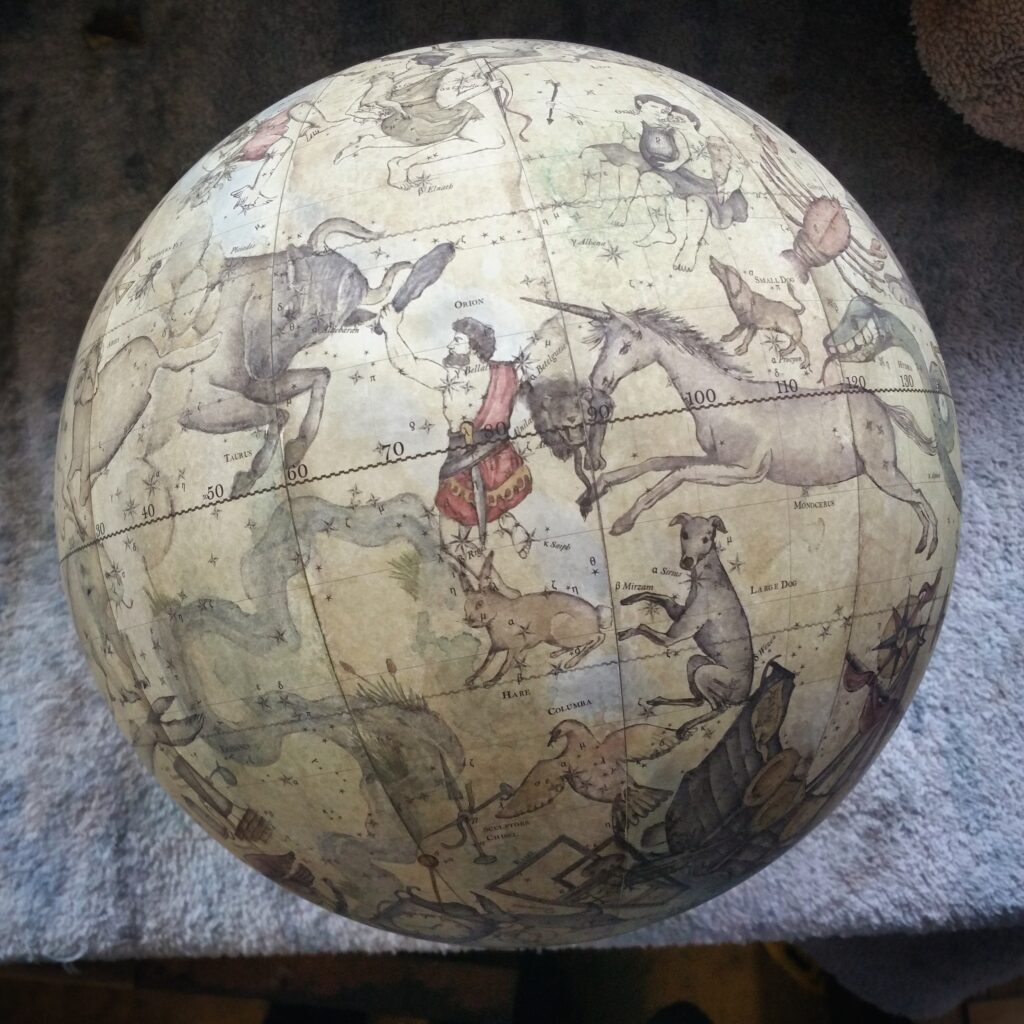
A celestial sphere can also refer to a physical model of the celestial sphere or celestial globe. Such globes map the constellations on the outside of a sphere, resulting in a mirror image of the constellations as seen from Earth……..
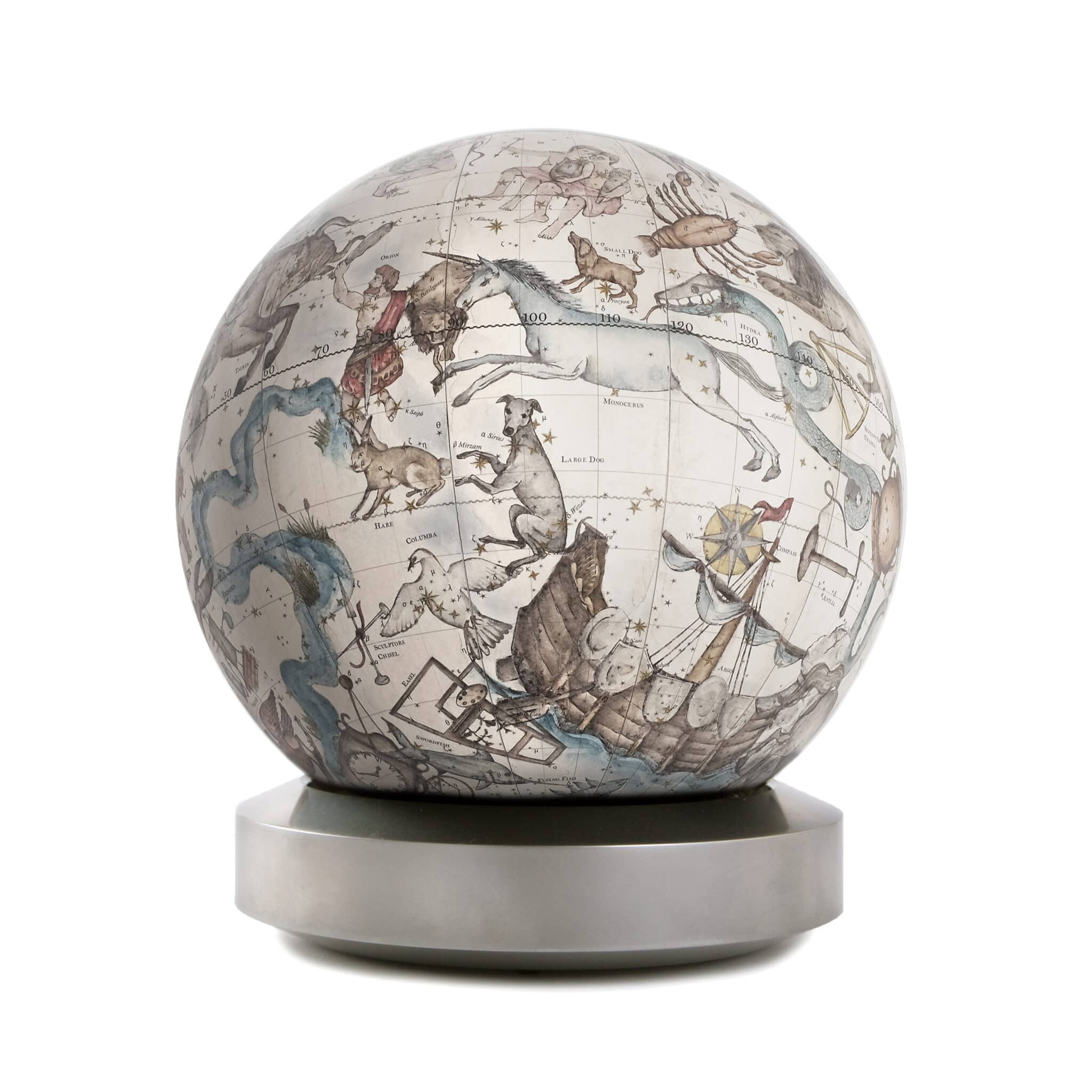


The Celestial Livingstone Globe.

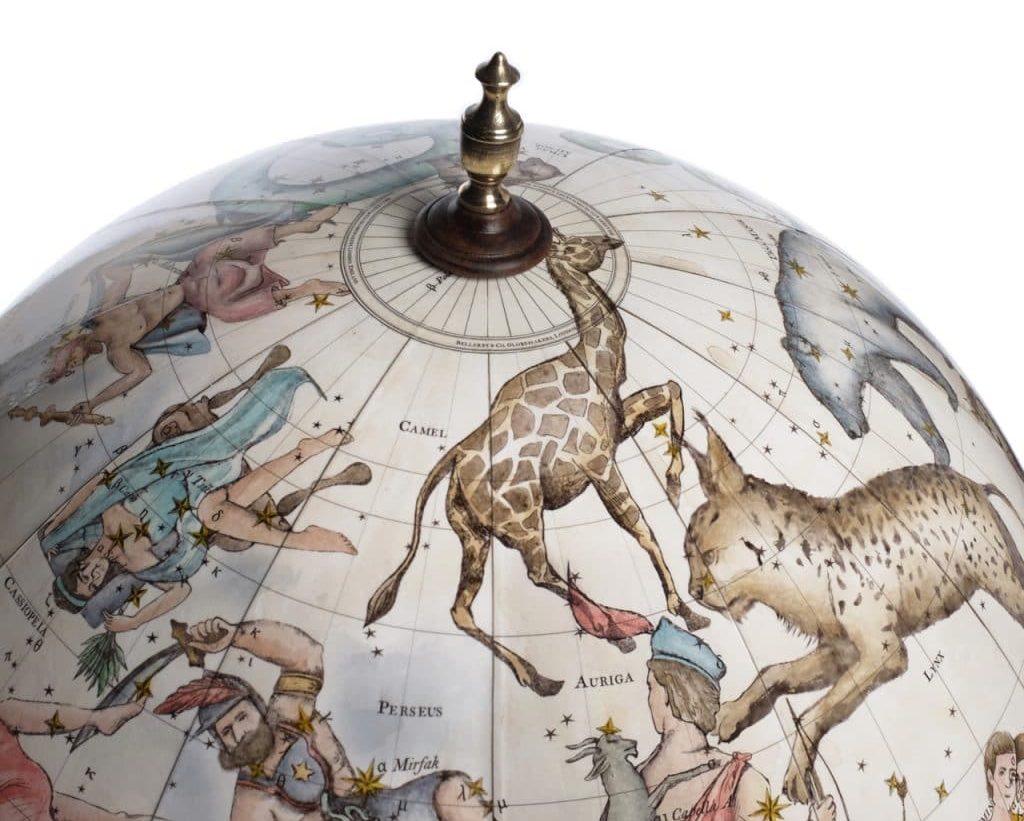


Bellerby & Co Globemakers, London
Modern and traditional bespoke globes, handcrafted and hand painted bespoke to order.
We ship worldwide from our London studio.
Each globe is one of a kind and can be personalised. We will work with you to finalise your choice of colouring, base style, base material and finish, and through the many options of customisation and personalisation.
Sizing from 12cm to 127cm diameter, desktop / tabletop and floor standing globes. Terrestrial and celestial.